
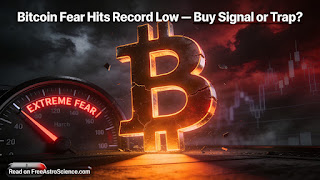

Bitcoin’s 22-Day Fear Spiral: What the Numbers Are Really Telling Us
Have you ever watched a pressure gauge drop so fast you weren’t sure
whether to panic — or lean in closer?
Welcome back to FreeAstroScience.com, where we explain
complex science and data in plain human terms. We’re Gerd Dani and the
whole FreeAstroScience team. We spend our days mapping galaxies,
untangling physics equations, and — yes — reading market sentiment charts
when they become genuinely fascinating. And right now, the Bitcoin Fear
and Greed Index is one of the most fascinating data stories on the
planet.
What you’ll find in this article isn’t hype. It’s a clear-eyed,
data-driven look at one of crypto’s most dramatic sentiment events in
history. We’ll walk you through what the index actually measures, why
it’s at record lows, what on-chain signals are quietly saying, and what
any of this means for the road ahead. Stay with us to the end — it’s
worth it.
At FreeAstroScience, we believe knowledge is the most powerful force in
the universe. We exist to keep your mind active at all times, because —
as Francisco Goya once warned — the sleep of reason breeds
monsters.
What Is the Bitcoin Fear and Greed Index?
Think of it as a thermometer for collective human emotion in the
cryptocurrency market. The Crypto Fear and Greed Index,
created by Alternative.me, assigns a single number — from
0 to 100 — to the overall mood surrounding Bitcoin and
the broader crypto market.
A score near 0 signals extreme fear: investors are
scared, selling fast, and avoiding risk. A score near
100 signals extreme greed: FOMO is maxed out, everyone
wants in, and prices are surging. Most seasoned investors know the
historical pattern well — when the crowd is most terrified, that’s
often when the most attractive prices appear.
Knowing this intellectually and acting on it calmly, though, are two
entirely different things. That gap between knowledge and action is
exactly what makes February 2026 so worth examining carefully.
How Is the Score Actually Built?
Six distinct data sources feed into a weighted composite score.
Here’s the formula that drives everything:
F&G = (V × 0.25) + (M × 0.25) + (S × 0.15)

      + (D × 0.10) + (T × 0.10) + (Sv × 0.15)
V = Volatility — current price swings vs. 30-day & 90-day averages (25%)
M = Market Momentum & Volume — current volume vs. 30-day average (25%)
S = Social Media — Reddit & Twitter engagement velocity (15%)
D = Bitcoin Dominance — rising BTC share signals fear-driven flight from altcoins (10%)
T = Google Trends — Bitcoin-related search query volumes (10%)
Sv = Surveys — weekly polls (currently paused by Alternative.me) (15%)
Volatility and market momentum carry 50% of the total weight
combined — which makes sense. When prices swing violently and buyers
disappear, the index collapses fast. That’s precisely what happened in the
first week of February 2026, and understanding this weighting helps explain
why the drop was so sharp.
The Numbers That Define February 2026
Numbers don’t lie — even when the market does. Here’s a snapshot of
where things stood as of February 22, 2026:
All-time F&G low
Feb 6, 2026
Current F&G reading
Feb 21–22, 2026
Bitcoin all-time high
October 2025
Cycle bottom
Feb 6, 2026
Drawdown from ATH
Liquidations in 24h
Feb 5–6, 2026
On February 6, 2026, Bitcoin hit a cycle low of
$60,062 — a full 52% below its October 2025 peak of
~$126,000. That same day, the Fear and Greed Index touched
5, the lowest reading ever recorded by the indicator.
That eclipsed the previous floor of 6, set during the
Terra/Luna collapse in June 2022. By February 22, Bitcoin had stabilized
near $67,000–$67,700, but the index remained stuck in
single digits — the 22nd consecutive day of extreme fear.
To put the $2 trillion erased from total crypto market capitalization in
perspective: that’s roughly the combined GDP of Spain and the Netherlands
— vanished from balance sheets in a matter of days.
How Did a Perfect Macro Storm Form?
Markets don’t crash in a vacuum. Several independent forces collided
here. Each one alone would have been manageable; together, they were
overwhelming.
The Fed Holds Firm
On January 28, 2026, the Federal Reserve held interest
rates at 3.50%–3.75%. Chair Powell was explicit: they
were “not in a hurry to cut.” That single statement crushed hopes for
cheaper money, kept real yields elevated, and pushed investors out of
risk assets. Crypto — arguably the most risk-sensitive asset class in
existence — took the hardest hit.
Tariff Shocks Rattle Global Markets
President Trump’s renewed tariff threats — targeting European and Chinese
imports including semiconductors, copper, and autos — shook global risk
appetite. The crypto market felt this directly. On
February 1, 2026 — quickly labeled “Black Sunday
II” across trading communities — total crypto market cap collapsed to
$2.66 trillion. Bitcoin dropped below $80,000, Solana
fell 9.24%, and BNB lost 7.15% in a single session.
Bessent’s Congressional Bombshell
The sell-off accelerated on February 4, 2026, when
Treasury Secretary Scott Bessent explicitly rejected any government
bailout authority or plans for strategic Bitcoin purchases during
congressional testimony. Institutional confidence cracked almost
immediately. Over $16 billion in futures liquidations
cascaded through the market across the following days.
ETF Outflows Remove the Floor
Spot Bitcoin ETFs — the institutional vehicle that helped push Bitcoin
to $126,000 — recorded $1.3–$1.5 billion in weekly net
outflows during the first week of February. That removed the
consistent buy-side support that had held prices during earlier
corrections. When institutional money exits, retail capital tends to
follow.
| Date | BTC Price Range | Key Catalyst | 24h Change |
|---|---|---|---|
| Jan 28–31 | $118,000 → $108,000 | Fed “higher-for-longer” statement + tariff rhetoric | −8.5% |
| Feb 1–2 | $108,000 → $92,000 | ETF outflows accelerate; funding rates flip negative | −14.8% |
| Feb 4 | ~$80,000 | Bessent rejects BTC purchases; algorithmic stop cascades begin | −9.2% |
| Feb 5–6 | ~$61,000 → $60,062 | $1.26B liquidations in 24h; F&G hits all-time low of 5 | −22.4% |
| Feb 21–22 | ~$67,000–$67,700 | Consolidation phase; F&G 7–8; day 22 of extreme fear | Stable |
What Is On-Chain Data Whispering?
Here’s where the story gets genuinely interesting. While the sentiment
gauge is screaming “run,” the on-chain data is telling a quieter,
far more patient story — and those two narratives don’t fully agree.
Exchange Reserves Keep Draining
Bitcoin exchange reserves — the amount of BTC sitting on centralized
platforms and available for sale — fell to approximately
2.47 million BTC by late January 2026. That’s one of
the lowest levels since 2018. Over 450,000 BTC have left
exchanges since January 2025. Coins that leave exchanges
typically move to cold storage wallets, which signals one thing:
holders are choosing to hold, not sell.
Think of it like inventory management. Fewer coins on shelves means
less immediate selling pressure. The fire is burning, but the fuel tank
is nearly empty.
Long-Term Holders Stay Calm
According to analyst Alice Liu at AInvest, a significant portion of
Bitcoin’s circulating supply now sits in long-term wallets, ETFs, or
corporate treasuries. This “reduction in circulating supply has
exacerbated volatility” — but it also means that most holders with
strong conviction haven’t blinked. The capitulation story is largely
being driven by leveraged short-term traders, not by the patient
long-term base.
Historical Extremes: Panic or Pivot?
Let’s zoom out and compare the current fear reading to the most
dramatic prior events. Context turns noise into signal.
| Event | Date | F&G Score | BTC Price at Low | Zone |
|---|---|---|---|---|
| COVID-19 Market Crash | Mar 2020 | 8 | ~$3,900 | Extreme Fear |
| Terra / LUNA Collapse | Jun 2022 | 6 | ~$17,600 | Extreme Fear |
| FTX Exchange Collapse | Nov 2022 | 7 | ~$15,800 | Extreme Fear |
| February 2026 Crash | Feb 6, 2026 | 5 ★ All-Time Low | ~$60,062 | Extreme Fear |
Every single event listed above was followed by a significant price
recovery in the months that came after. That’s not a guarantee — it’s
a pattern. And patterns, especially recurring ones, deserve respect.
goes contrary to the expectations of the majority — with the probability
of a contrarian reversal highest during extreme sentiment zones.”
— NewsBTC, February 2026
The 2022 bear market, though, offers a cautionary footnote: even after
the Fear and Greed Index bottomed, the market spent several more weeks
grinding through the extreme fear zone before a real bottom formed.
No signal is clean. No bottom rings a bell.
Who Are the Whales Moving the Market?
In a market with thin order books, large players can move prices in
either direction with a single transaction. Here’s what the biggest
hands did in February 2026 — and what it might mean.
The Cold Storage Accumulator (Feb 8)
On February 8, 2026, blockchain analytics firm
Lookonchain flagged a single Binance withdrawal of
1,546 BTC — approximately $106.7 million — moved
directly into cold storage. Large cold-storage withdrawals are
typically a long-term accumulation signal: someone bought the dip
and has no intention of selling anytime soon.
The Seller (Feb 20)
Twelve days later, a separate whale deposited
11,318 BTC (~$760 million) into Binance.
Approximately 60% of that position was subsequently sold,
adding meaningful short-term selling pressure to an already thin order
book. Markets under stress are tug-of-wars — accumulation at some
levels, distribution at others. Both can happen simultaneously.
The Kiyosaki Signal (Feb 22)
On February 22, 2026, best-selling author and
Rich Dad Poor Dad creator Robert Kiyosaki publicly disclosed
that he purchased one Bitcoin at $67,000, calling it
a hedge against a weakening U.S. dollar. One coin isn’t a market-moving
trade — but public statements from high-profile buyers during periods of
extreme fear carry narrative weight. They shift how people frame their
own decisions.
Is This a Contrarian Buying Signal?
Warren Buffett’s most-quoted line applies here just as powerfully as it
does in traditional markets: “Be fearful when others are greedy, and
greedy when others are fearful.” With the index pinned at 7–8 for
22 straight days — the longest sustained extreme-fear run in the index’s
history — that question is entirely reasonable to ask.
Economist Timothy Peterson projected Bitcoin could reach
$122,000 by year-end 2026. Several other analysts see
price targets as high as $150,000, interpreting the
current fear as a potential loading zone for patient capital. However,
Kaiko analyst Laurens Fraussen issued a measured
warning: “thin order books and a lack of buyer confidence at
intermediate price levels” create a genuine “risk of further
declines under modest selling pressure.”
Here’s our honest read: nobody knows exactly where the floor is. What
we do know is that extreme fear readings of this depth have historically
preceded significant recoveries — though the timeline is never clean.
If you believe in Bitcoin’s long-term fundamentals, the data points
toward patience rather than panic. If you’re trading short-term, the
order book is a real and present warning.
Either way, the worst move right now is turning off your brain. The
market is designed to make you panic. Don’t give it what it wants.
Our Take: Fear Is Loud, Data Is Quiet
Twenty-two straight days of extreme fear. An all-time index low of 5.
A 52% drawdown from Bitcoin’s $126,000 peak. Macro pressure from every
angle — the Fed, tariffs, institutional outflows, a Treasury Secretary
who killed the government-backstop dream in one congressional sentence.
On paper, this sounds like a catastrophe.
But when you look past the noise — the liquidation alerts, the social
media doomsayers, the avalanche of red candles — a quieter signal
emerges. Exchange reserves near decade lows. Long-term holders not
moving. Whales pulling coins to cold storage even as prices fall.
Historical precedent showing that every comparable fear event has
eventually given way to recovery.
We’re not telling you to buy or sell. We’re telling you to
keep thinking. That’s what we do here at
FreeAstroScience — whether we’re explaining a black hole, a quantum
paradox, or a broken sentiment index. Clear thinking in moments of
chaos is a skill, and like any skill, it needs practice.
Come back to FreeAstroScience.com to keep that
practice going. We’ll keep the light on — and the reason wide awake.