
A One-Way Journey Through the Darkest Place in the Universe
“Have you ever looked up at the night sky and wondered — what would
actually happen if you fell into a black hole?”
Welcome to FreeAstroScience, where we take the most
mind-bending ideas the universe has to offer and make them real,
human, and — if we do our job right — a little bit thrilling.
I’m Gerd Dani, your guide today, and I’ll be honest with you:
this topic still gives me chills every single time I sit down
to write about it.
We’re going somewhere no spacecraft has ever gone, and from which
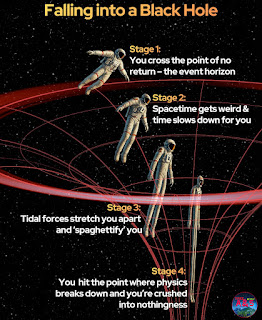
no signal has ever returned. We’re going to walk through four
distinct stages of falling into a black hole — from the invisible
threshold of the event horizon all the way to the place where
the laws of physics break down and admit they have no answer.
Here at FreeAstroScience, we believe the sleep of reason breeds
monsters. So we keep the mind awake, always. Read this
article to the end, and you’ll walk away with a genuine,
science-backed understanding of one of the most extraordinary
corners of the cosmos.
What Exactly Is a Black Hole?
Start simple. A black hole is a region of space where gravity has
grown so extreme that nothing can escape — not matter, not light,
not a radio signal, not anything — once it crosses a certain
boundary. That boundary is the event horizon.
Most black holes form when massive stars collapse under their own
weight at the end of their lives. But at the centers of most
large galaxies — including our own Milky Way — sit
supermassive black holes that are millions
or even billions of times heavier than our Sun. Some have masses
up to 100 billion times the mass of the Sun,
and we still don’t fully understand how they got so large.
From the outside? A black hole looks surprisingly unremarkable.
A dark sphere. Stars surrounding it. Maybe a glowing ring of
hot gas — the accretion disc — orbiting it
like a slow, lethal halo. Physics only starts misbehaving
when you get closer.
The first direct image of a black hole was captured in April 2019
by the Event Horizon Telescope collaboration.
It showed M87* — a supermassive black hole roughly
6.5 billion times the mass of the Sun,
located about 55 million light-years from Earth. The image of
our own galaxy’s central black hole, SgrA*, followed in 2022.
Stage 1: Do You Feel Anything at the Event Horizon?
The Event Horizon — The Point of No Return
Here’s the fact that surprises almost everyone: you wouldn’t
feel a thing when you cross the event horizon. No wall.
No alarm. No flash of light. The event horizon isn’t a physical
surface at all. It’s a mathematical boundary — the precise
distance from the center where escaping would require traveling
faster than 186,000 miles per second
(300,000 km/s). That’s the speed of light. Nothing reaches
that speed. So once you’re past it, there’s no going back.
Why doesn’t anything feel different at the boundary?
Einstein’s equivalence principle gives us the answer. Free fall
feels like weightlessness. Jump off a cliff with no air resistance,
and your body detects no gravitational force — you’re simply moving
through curved spacetime. Falling toward a black hole works
exactly the same way. Your pulse stays steady. Your thoughts stay
clear. You’re just falling. The event horizon marks the end of
all possibility, not the end of your comfort — and that’s precisely
what makes it so philosophically unsettling.
able to change your mind.”
The Schwarzschild Radius
Every black hole has an event horizon defined by its mass.
German physicist Karl Schwarzschild calculated the formula
for it in 1916, while serving on the Eastern
Front during World War I. His result: every object has a
“critical radius” — squeeze it below that size, and it collapses
into a black hole. If you compressed our entire Sun into a sphere
just 3 kilometers wide, it would become one.
The Earth? You’d need to squeeze it smaller than a marble —
about 9 millimeters across.
That radius is called the Schwarzschild radius,
and it scales directly with mass. Double the mass, and the event
horizon is twice as large. This relationship has a surprising
consequence for spaghettification — which we’ll get to in
Stage 3.
Stage 2: What Happens to Time as You Fall Deeper?
Time Unravels — The Universe Speeds Up Around You
Past the horizon, spacetime curves more and more sharply.
From your own perspective, nothing feels wrong. Your watch
ticks normally. But look outward — toward the distant galaxies —
and something astonishing happens. The rest of the universe seems
to accelerate. Light from faraway stars shifts to shorter
wavelengths, growing brighter and bluer. You’re watching billions
of years of cosmic history compressed into the final moments
of your descent.
Every path in spacetime points inward
This is the deepest truth about the inside of a black hole.
Once you’ve crossed the event horizon, every path you can take
through spacetime — every possible direction of travel —
curves inward toward the singularity. Not “hard to leave.”
Not “you’d need enormous energy.” There is simply
no path that leads out. The singularity sits in
your future the same way tomorrow morning does: certain,
unavoidable, and approaching whether you want it to or not.
Inside a black hole, the singularity isn’t a place
you’re moving toward. It’s a moment in time.
You can’t dodge it any more than you can dodge Tuesday.
This reframing of the singularity as a future moment rather
than a location is one of general relativity’s most beautiful
— and most disturbing — predictions. Space and time effectively
swap roles inside the event horizon. Time becomes the radial
coordinate. The center is always ahead of you.
Stage 3: Spaghettification — Will You Become Cosmic Pasta?
The Stretch — Tidal Forces Take Over
Yes — spaghettification is a genuine scientific term,
and it describes exactly what it sounds like.
Gravity doesn’t pull your whole body with equal force. The part of
you closest to the black hole gets pulled harder than the part
that’s farther away. This difference in gravitational pull is a
tidal force, and it grows rapidly as you approach
the center. Your feet (going in feet-first) get yanked harder than
your head. At the same time, everything gets squeezed inward from
the sides, because every part of your body is being pulled toward
the same central point. You stretch vertically. You compress
horizontally. Long, thin, pasta-like.
Tidal forces aren’t unique to black holes. The Moon pulls
on the near side of Earth slightly harder than the far side —
and that tiny difference is enough to produce our ocean tides.
Near a black hole, that same principle is taken to its most
violent extreme, and the “tide” doesn’t just move water.
It shreds stars.
Has spaghettification ever been observed?
Remarkably, yes. When a star wanders too close to a supermassive
black hole, tidal forces overpower the star’s own self-gravity and
internal pressure. The star stretches into a long, curving stream
of gas. Astronomers call these events
Tidal Disruption Events (TDEs), and they release
powerful bursts of X-ray, ultraviolet, and optical radiation
visible across millions of light-years. We’ve confirmed dozens
of them.
In October 2019, researchers at UC Berkeley
identified the closest TDE ever observed at the time. A star
similar in mass to our Sun was spaghettified by a supermassive
black hole in a spiral galaxy in the Andromeda constellation.
For the first time, scientists were able to study the event
in visible light — and found that most of the shredded stellar
material was ejected away from the black hole,
not swallowed. A mystery we’re still unpacking.
If you fall through a black hole’s accretion disc — a swirling,
superheated cloud of gas — tidal forces aren’t your only concern.
Friction in that disc generates intense electromagnetic radiation,
including high-energy X-rays and gamma rays.
For a human body, that adds another layer of physics-fueled
catastrophe well before the tidal forces peak.
Does the Size of the Black Hole Change Your Fate?
Absolutely — and the answer is counterintuitive. Bigger isn’t
always more immediately dangerous.
Recall that the Schwarzschild radius scales directly with mass.
A stellar-mass black hole of about 10 solar masses has an event
horizon roughly 30 kilometers across. Falling
toward that tiny horizon, the difference in gravitational pull
between your feet and your head is catastrophic before
you even cross it. A supermassive black hole of one million solar
masses has a Schwarzschild radius of about
3,000 kilometers — and at that much larger
horizon, the tidal gradient is far gentler. You’d cross the
threshold comfortably. The spaghettification comes later,
closer to the singularity.
| Property |
Stellar-Mass Black Hole (~10–100 solar masses) |
Supermassive Black Hole (millions–billions of solar masses) |
|---|---|---|
| Schwarzschild radius | ~30–300 km | Millions of km |
| Spaghettification begins | Before crossing the event horizon | Well after crossing the event horizon |
| Tidal force at the event horizon | Extreme — body destroyed before entry | Gentle — comparable to ~80 g weight on a 1 m, 80 kg object |
| Time to singularity after crossing | Microseconds to milliseconds | Hours to years (mass-dependent) |
| Real example | Cygnus X-1 (~21 solar masses) | M87* (~6.5 billion solar masses) |
| Gravitational time dilation at horizon | Extreme (same physics applies) | Extreme (same physics applies) |
This inverse relationship between black hole mass and tidal force
at the horizon comes directly from the math. Double the mass,
and the tidal force at the event horizon drops by a factor of
four. A concrete example makes this vivid:
for a 1-meter, 80 kg object approaching a 10-solar-mass
stellar black hole, the tidal force at the event horizon
is equivalent to hanging roughly
800 million kilograms from its feet.
For the same object approaching a one-million-solar-mass
supermassive black hole, that same force at the horizon
is equivalent to hanging just 80 grams
— the weight of a small apple. Same physics, completely
different experience.
The Math Behind the Madness
Two equations sit at the heart of everything we’ve discussed.
They’re not as intimidating as they look — and understanding
them will sharpen everything else.
// The radius at which escape velocity equals the speed of light
| Rs | Schwarzschild radius (meters) — the event horizon size |
| G |
Gravitational constant = 6.674 × 10⁻¹¹ N·m²/kg² |
| M | Mass of the black hole (kilograms) |
| c |
Speed of light = 299,792,458 m/s (≈ 300,000 km/s) |
Ftidal ≈ 2GMmΔr / r³
// Differential gravitational force stretching a falling body
| Ftidal | Tidal (stretching) force in Newtons |
| G |
Gravitational constant = 6.674 × 10⁻¹¹ N·m²/kg² |
| M | Mass of the black hole (kg) |
| m | Mass of the falling object (kg) |
| Δr | Length of the object along the radial direction (meters) |
| r | Distance from the black hole’s center (meters) |
The tidal force grows as r³ decreases — the closer
you get, the faster the stretching accelerates. And since
the Schwarzschild radius scales as Rs ∝ M,
the tidal force at the event horizon itself turns out to be
proportional to 1/M². That single algebraic
consequence explains everything in the comparison table above:
bigger black holes, gentler horizons.
Stage 4: What Waits at the Singularity?
The Singularity — Where Physics Runs Out of Words
At the center of a black hole, according to general relativity,
lies the singularity: a mathematical point of
infinite density and infinite spacetime curvature. You’d reach
it in a finite time on your own clock — seconds to hours after
crossing the event horizon, depending on the black hole’s mass.
And when you get there? The equations break down. Density rises
without limit. Curvature rises without limit. General relativity
— one of the most accurate theories ever written — simply stops
giving answers.
Does the singularity actually exist?
The Singularity Theorem, proved by Roger Penrose
and recognised with the Nobel Prize in Physics 2020,
shows that once matter crosses an event horizon, a singularity
must form under general relativity. But “must form under general
relativity” doesn’t mean it truly exists in the physical universe.
General relativity is a classical theory. The real universe is
quantum. Most physicists believe that a future theory of
quantum gravity will replace the singularity with
something finite — a region of extreme but non-infinite density
where quantum effects dominate.
Several candidate models already exist. In
loop quantum gravity, the quantum structure
of spacetime could produce a “Planck star” instead of a singularity.
In string theory, a “fuzzball” of degenerate strings
replaces the point. Even within classical general relativity,
the Hayward metric — a minimal modification of
Schwarzschild — describes a non-singular black hole where the center
is locally flat rather than infinitely dense. We just don’t yet
know which description, if any, is correct.
Heisenberg’s uncertainty principle forbids an exact mass at
an exact point — suggesting quantum mechanics itself may
prevent true singularities from forming. The singularity is
where our best physics admits it doesn’t know the answer.
That’s not a failure of science; it’s an invitation.
What Does an Outside Observer See?
Here’s the strangest twist in the whole story. While
you fall smoothly through the event horizon, someone
watching from a safe distance sees something completely different.
They see you slow down. The light you emit stretches to longer
wavelengths — gravitational redshift — and your image grows
dimmer and redder. You appear to approach the horizon
asymptotically, never quite arriving, suspended at the edge
of eternity like a painting.
To your distant friend, you freeze at the horizon forever.
To you, you cross in a moment and keep falling. Two radically
different stories — both equally valid within general relativity.
This is the relativity of simultaneity taken
to its absolute limit. There’s no single “correct” account.
Just two observers living two entirely different realities
of the same event.
true at the same time. That’s not a paradox — that’s relativity.”
Can a Black Hole Actually Die?
In 1974, Stephen Hawking made a prediction that
shook theoretical physics: black holes aren’t perfectly black.
They glow. Extremely faintly, but they glow.
Using quantum field theory near the event horizon, Hawking showed
that black holes should emit faint thermal radiation — now called
Hawking radiation. Over an enormous timescale,
this causes the black hole to slowly lose mass and eventually
evaporate completely in a final burst of energy. For a
stellar-mass black hole, the evaporation time dwarfs the current
age of the universe by unimaginable orders of magnitude. But
the principle holds: everything ends.
Hawking radiation has never been directly detected — it’s far
too faint for any instrument we have. Yet it’s widely accepted
theoretically, and it opens a door to the deepest unsolved
problem in all of fundamental physics.
The Information Paradox: Your Last Unanswered Question
Quantum mechanics has a rule that sits at the foundation of all
physics: information cannot be destroyed. The
details of every particle — its position, spin, energy state —
must be preserved somewhere, even as particles rearrange into
new forms. Burn a book, and the information in it still exists,
in principle, scattered through the smoke and ash. It’s just
incredibly hard to recover.
Black holes seem to break that rule. You fall in — along with
all your atoms, and all their quantum information. The black hole
later evaporates via Hawking radiation. But Hawking radiation is
thermal — essentially random, like heat from a warm rock.
It doesn’t carry the specific quantum imprint of what fell in.
So where did your information go?
This is the black hole information paradox,
and physicists have wrestled with it for over fifty years.
Recent work on holographic principles — led
by researchers like Juan Maldacena — suggests that information
may be somehow encoded in subtle correlations within the
Hawking radiation itself, spread too thinly to read but
technically preserved. Alternative models without classical
event horizons — such as the Hayward metric — suggest
information might gradually escape over time. The argument
isn’t settled.
“Regular black hole” models — including those based on the
Hayward metric — are now actively studied as physically
motivated alternatives that eliminate both the singularity
and the classical event horizon. From the outside, these
objects are nearly indistinguishable from standard Schwarzschild
black holes. But deep inside, they behave entirely differently.
The data from the Event Horizon Telescope is consistent with
both models, so the question remains genuinely open.
Before You Go: What Did We Learn?
Falling into a black hole unfolds in four acts. You’d cross the
event horizon without a tremor — an invisible
line where escape requires the speed of light and every spacetime
path curves inward. Time would warp around you, the distant
universe accelerating in fast-forward. Then
tidal forces would begin their work: violent and
immediate near a stellar-mass hole, drawn-out and strangely
gentle near a supermassive one, but inescapable in either case.
And at the singularity, general relativity hands
back a blank sheet of paper. What happens next is the greatest
open question in modern physics — and genuinely no one knows the
full answer.
What I find remarkable, every time we revisit this thought
experiment, is how quietly gravity does its work. No explosion.
No warning label. Just the geometry of spacetime reshaped until
every road forward points to the same place. That’s not
terrifying — it’s extraordinary. The universe doesn’t ask
permission, and it doesn’t owe us symmetry.
We at FreeAstroScience build these articles
because we believe your mind deserves to stay active. The sleep
of reason breeds monsters — and there are too many beautiful
questions left to let curiosity go quiet. Keep asking. Keep
reading. Every answer opens three new doors.
Come back to
FreeAstroScience.com whenever you want to
go deeper. We’ll always leave the door open — just, maybe,
not the one near the event horizon.