
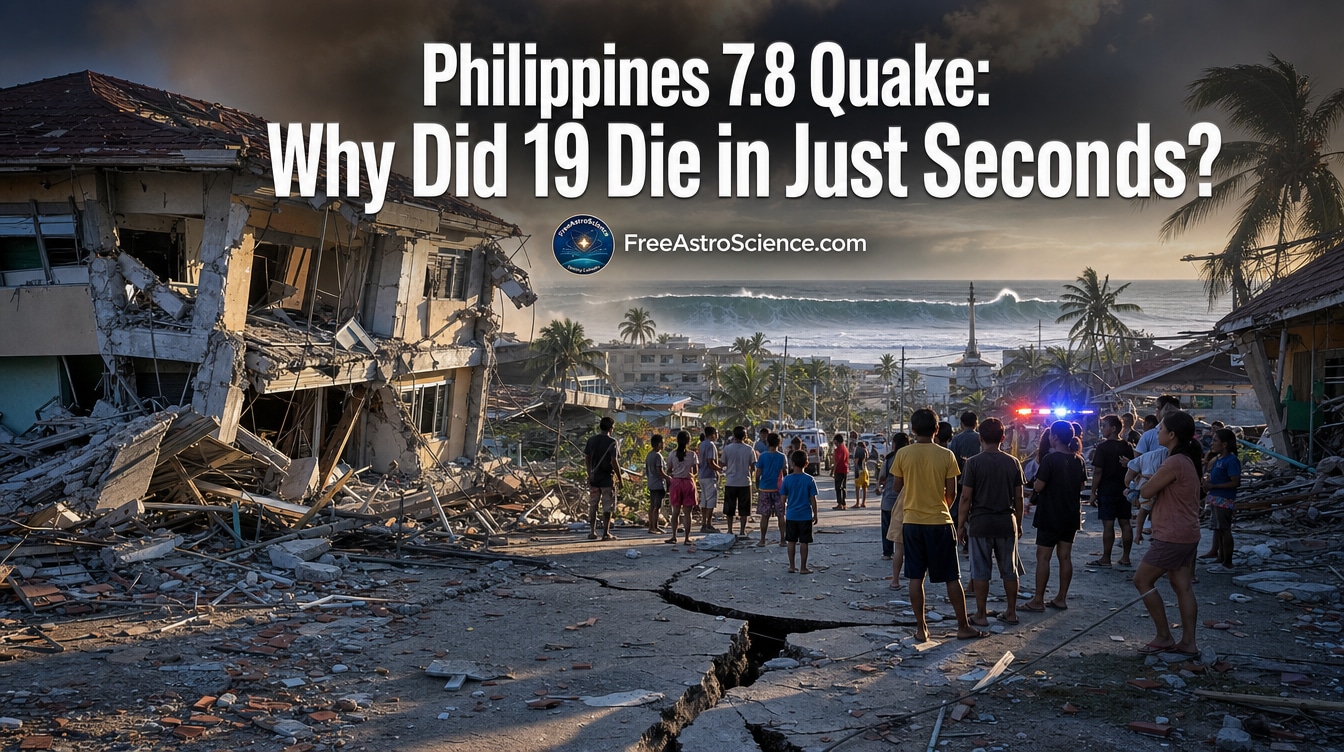
When the Earth Shook Mindanao: Inside the 7.8 Magnitude Quake That Rocked the Philippines
Have you ever wondered what it feels like when the ground beneath your feet betrays you in seconds?
Welcome, dear reader. We’re glad you stopped by FreeAstroScience.com today. I’m Gerd Dani, writing to you from my desk as President of Free AstroScience, and what happened on June 8, 2026, in the southern Philippines deserves more than a passing headline. It deserves your full attention. Stay with us until the last line — by then, you’ll grasp not just what happened, but why it happened, and what the planet is trying to tell us.
📑 Table of Contents
- What Exactly Happened on June 8, 2026?
- How High Is the Human Cost?
- Why Did a Tsunami Warning Reach Japan?
- What Geological Forces Caused This Quake?
- The Numbers at a Glance
- Why Are the Philippines a Seismic Hotspot?
- How Did the Country Respond?
- Final Thoughts
- FAQ
What Exactly Happened on June 8, 2026?
At 7:37 a.m. local time (1:37 a.m. in Italy), a violent magnitude 7.8 earthquake tore through the southern Philippines . The U.S. Geological Survey confirmed the figure. The Philippine Institute of Volcanology and Seismology (PHIVOLCS) had first measured it at 7.0 before revising upward .
The epicenter? Offshore. About 26 kilometers southwest of Kablalan, in Sarangani province, on the island of Mindanao. The hypocenter sat at roughly 33 km deep — shallow enough to send brutal shockwaves through coastal cities.
Then came the aftershocks. PHIVOLCS recorded 138 of them, ranging from magnitude 1.3 to a worrying 6.7. Picture that for a moment. After the main blow, the earth kept trembling for hours, denying anyone the comfort of “it’s over.”
How High Is the Human Cost?
The latest figures are sobering. At least 19 people have died, and more than 134 are injured, according to civil defense officials. These numbers are still being verified by the National Disaster Risk Reduction and Management Council.
General Santos — a southern port city home to over 700,000 people, famous as the country’s tuna capital — was hit hard . A three-story building housing a restaurant collapsed in a cloud of dust and debris, caught on video that quickly spread across social media . Other footage showed shattered glass, caved-in roofs, and a Jollibee restaurant reduced to rubble.
The timing made things worse. The quake struck on the first day of the new school year in the Philippines. President Bongbong Marcos suspended classes in affected areas immediately . In Cotabato City, every public and private school was shut. Patients at Kidapawan City hospital had to be evacuated to open ground . General Santos International Airport stopped operations.
Why Did a Tsunami Warning Reach Japan?
Within minutes, the Pacific Tsunami Warning Center issued an alert. Waves of up to 3 meters were possible along Philippine coasts, and up to 1 meter along the shores of Indonesia and Malaysia .
PHIVOLCS director Teresito Bacolcol confirmed that coastal monitoring stations detected waves of about 1 meter in Sultan Kudarat and Sarangani provinces . Anomalous waves showed up at nine sites, with a peak of 75 cm on Sangihe Island .
The alert reached far. Japan (including Okinawa), Taiwan, Papua New Guinea, Indonesia, plus several western Pacific islands and territories all received tsunami warnings . Australia and New Zealand also issued alerts but lifted them quickly. Observed waves ranged from a few centimeters up to 1.4 meters (4.6 feet).
About five hours after the main shock, the tsunami warning was withdrawn — though authorities urged everyone to stay vigilant.
What Geological Forces Caused This Quake?
Here’s where the science gets fascinating, and a bit unsettling.
According to PHIVOLCS, the location of the quake and the spread of aftershocks point to one culprit: subduction along the Cotabato Trench.
What does that mean in plain words? Two of Earth’s tectonic plates are colliding. The denser one slides beneath the lighter one. This isn’t smooth — it’s a slow, grinding fight that builds up enormous stress over decades, sometimes centuries. When the rock finally snaps, you get the kind of energy release we saw on June 8.
📐 The Energy Math
A magnitude 7.8 quake releases roughly 32 times more energy than a magnitude 6.8, and about 1,000 times more than a magnitude 5.8. The Richter-style scale is logarithmic, meaning each whole number jump multiplies the shaking energy dramatically.
E ∝ 101.5 × M
The Numbers at a Glance
| Parameter | Value |
|---|---|
| Date & Time (local) | June 8, 2026 — 07:37 |
| Magnitude | 7.8 (USGS) |
| Epicenter | 26 km SW of Kablalan, Sarangani |
| Depth | ~33 km |
| Confirmed deaths | At least 19 |
| Injured | More than 134 |
| Aftershocks recorded | 138 (M 1.3 – 6.7) |
| Max tsunami wave | 1.4 m (4.6 ft) |
| Geological cause | Subduction along Cotabato Trench |
Why Are the Philippines a Seismic Hotspot?
The Philippines sit right on the Pacific Ring of Fire — the most seismically and volcanically restless belt on Earth. This horseshoe-shaped zone, stretching some 40,000 km around the Pacific Ocean, hosts about 75% of the planet’s active volcanoes and roughly 90% of its earthquakes.
Why? Because it’s where many of Earth’s tectonic plates meet, push, dive, and grind against each other. The Cotabato Trench is one of these meeting points. The Sunda Plate and the Molucca Sea Plate fight a slow battle there, and Mindanao sits in the front row.
We can’t predict when the next big one will strike. But we can understand the mechanisms. That knowledge is what saves lives — through better building codes, faster warning systems, and smarter evacuation drills.
How Did the Country Respond?
The reaction came fast and broad. President Marcos pledged that the government “will not leave Mindanao behind”. The Philippine Red Cross declared its highest alert level. Evacuation and relief operations began across the affected provinces
Schools shut down. The airport closed. Hospitals moved patients outside as aftershocks kept rolling through. It was, in many ways, a textbook emergency response — but no protocol can erase the trauma of watching your neighborhood crumble.
Final Thoughts
This article was crafted especially for you by FreeAstroScience.com, where we translate complex scientific principles into plain language so anyone, anywhere, can understand them. We believe knowledge belongs to everyone — not just to academics behind paywalls.
Earth doesn’t care about our schedules, our school calendars, or our tuna exports. It moves on geological time, indifferent to ours. Yet by studying its rhythms — the subduction zones, the trenches, the slow dance of plates — we gain something precious: warning, preparation, and ultimately, lives saved.
The 19 lives lost in Mindanao remind us that science isn’t an abstract pursuit. It’s a defense system for our species. The more we understand subduction, the more we can predict where danger lives. The more we model tsunamis, the faster we can clear the beaches.
At FreeAstroScience, we never want you to switch off your mind. The sleep of reason breeds monsters. Keep questioning. Keep reading. Keep your curiosity awake.
Come back to us whenever you want to sharpen your thinking. We’ll be here, ready to walk you through the next big story the universe throws at our planet.
Frequently Asked Questions
1. How strong was the June 8, 2026 Philippines earthquake?
The USGS confirmed a magnitude of 7.8, although PHIVOLCS first registered it at 7.0 before updating the figure . 2. Where exactly was the epicenter located?
Offshore, about 26 km southwest of Kablalan in Sarangani province, off the coast of Mindanao, with a depth of roughly 33 km . 3. Did a tsunami actually hit?
Yes, but smaller than feared. Waves of about 1 meter were detected in Sultan Kudarat and Sarangani, with a peak of 1.4 meters observed during the event. Sangihe Island recorded a 75 cm wave . 4. What caused the earthquake geologically?
PHIVOLCS attributes the quake to subduction along the Cotabato Trench, where one tectonic plate slides beneath another, releasing massive amounts of stored energy . 5. How many people were killed and injured?
As of the latest update, at least 19 people died and more than 134 were injured, with figures still subject to verification.




Excellent insights, really appreciate the detailed explanation.