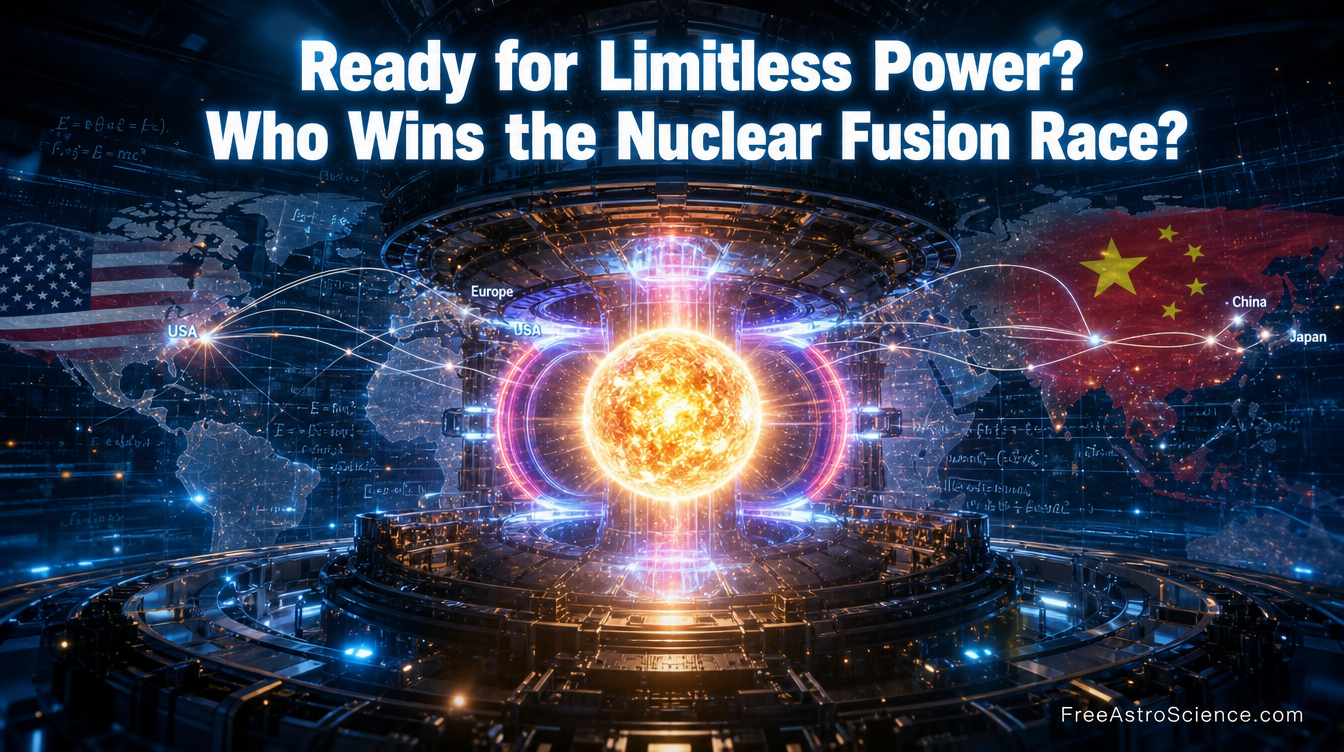
Who Will Win the Race for Nuclear Fusion? The U.S. and China Are in the Lead, but There Won’t Be a Single Winner
Can We Bring the Power of the Sun Down to Earth?
Have you ever looked up at the Sun and wondered if we could ever capture its power here on Earth? Imagine a world where energy is clean, safe, and nearly limitless—no more blackouts, no more fossil fuels, no more fear of radioactive waste. That’s the dream of nuclear fusion, and right now, the world’s brightest minds are racing to make it real.
Welcome to FreeAstroScience.com. I’m Gerd Dani—physicist, astronomer, science communicator, and yes, a young man in a wheelchair who believes that curiosity is the greatest force in the universe. Today, we’re diving into the global chase for nuclear fusion. The U.S. and China are leading the pack, but this isn’t a race with just one finish line or a single winner. It’s a story of competition, collaboration, and the hope that we can all share in the light of a new energy dawn.
Stick with us to the end. You’ll see why this race matters to you, to all of us, and why the real victory will belong to humanity as a whole.
- What Is Nuclear Fusion — and Why Should You Care?
- The Moment Everything Changed: NIF’s December 2022 Ignition
- The Science Behind the Fire: Fusion Reactions Explained
- The United States: Private Innovation at Warp Speed
- China’s Ambition: Record-Breaking Science, State-Backed Power
- Asia’s Other Fusion Giants: South Korea and Japan
- Europe and ITER: The World’s Most Ambitious Science Project
- Who Are the Private Fusion Companies to Watch?
- Comparing the World’s Major Fusion Programs
- Why There Won’t Be a Single Winner
- The Geopolitical Angle: Competition Meets Cooperation
- Conclusion
- FAQ
The Great Fusion Chase: When Stars Come Down to Earth
What Is Nuclear Fusion — and Why Should You Care?
Nuclear fusion is the process that powers the Sun and all the stars. It’s not just science fiction. It’s the “Holy Grail” of energy: clean, safe, and almost endless. Unlike nuclear fission (the process in today’s nuclear plants), fusion doesn’t split atoms—it fuses them together. The result? No long-lived radioactive waste, no meltdown risk, and enough energy to power civilization for millions of years.
But there’s a catch. To make fusion happen, we need to recreate the Sun’s core—temperatures over 100 million degrees Celsius, pressures that crush atoms together, and magnetic fields strong enough to hold a star in a bottle. It’s the ultimate scientific challenge, and for decades, it seemed just out of reach.
Now, the world is closer than ever. The race is on, and the finish line is in sight.
The Moment Everything Changed: NIF’s December 2022 Ignition
On December 5, 2022, at 1:03 a.m. PST, something historic happened at the National Ignition Facility (NIF) in California. Scientists fired 192 lasers at a tiny capsule of hydrogen fuel. For the first time, the fusion reaction produced more energy than the lasers put in—2.05 megajoules in, 3.15 megajoules out. That’s called “ignition,” and it’s the moment fusion stopped being a dream and became a fact.
By February 2024, NIF doubled its own record, reaching about 5 megajoules of output. By May 2026, NIF had confirmed its sixth successful ignition shot. These aren’t just numbers—they’re proof that fusion works, and that we’re not chasing a fantasy anymore.
The Science Behind the Fire: Fusion Reactions Explained
Let’s break down the magic. Fusion happens when two light atomic nuclei—usually isotopes of hydrogen—smash together and form a heavier nucleus, releasing a burst of energy. The most common reactions in labs are:
D + T → ⁴He (3.5 MeV) + n (14.1 MeV) → 17.6 MeV total
Deuterium (D) + Tritium (T) fusion: the main reaction in most experiments.
D + D → ³He + n + 3.27 MeV
D + D → T + p + 4.03 MeV
Deuterium-Deuterium fusion: alternative, but harder to achieve.
Lawson Criterion:n·τ·T > 3×10²¹ keV·s/m³
n = density, τ = confinement time, T = temperature. This “triple product” must be high enough for ignition.
Fusion Gain Q:Q = Efusion / EinputQ > 1 = ignition
Fusion is hard. The Sun has gravity to help. We have to use lasers, magnets, and a lot of ingenuity.
The United States: Private Innovation at Warp Speed
The U.S. is racing ahead with a mix of government vision and Silicon Valley-style innovation. The Department of Energy’s “Bold Decadal Vision for Commercial Fusion Energy” aims for a working prototype by the early 2030s. The 2026 Fusion Science & Technology Roadmap—“Build–Innovate–Grow”—targets commercial fusion on the grid by the mid-2030s.
Money is flowing. The DOE Fusion Energy Sciences budget for 2026 is $744.8 million. Programs like the Milestone-Based Fusion Development Program ($415 million authorized, $46 million already awarded to 8 companies), FIRE Collaboratives ($128 million announced in 2026), and INFUSE ($6.1 million in new awards) are fueling a private sector boom.
Private investment in U.S. fusion startups has exploded—over $15 billion globally by early 2026, with the U.S. home to 42 of the world’s 77 private fusion companies. The American model is 94.5% private capital. That means fierce competition, fast pivots, and a willingness to try new ideas.
China’s Ambition: Record-Breaking Science, State-Backed Power
China isn’t just catching up—it’s setting records. With 34% of global fusion investment (€4.4 billion), and $6.5 billion spent between 2023 and 2025 alone, China’s approach is bold and state-driven. The Experimental Advanced Superconducting Tokamak (EAST) in Hefei is a world leader. In 2023, EAST held plasma in “Super I-mode” for 1,056 seconds—over 17 minutes. Temperatures reached 120 million °C for 101 seconds and 160 million °C for 20 seconds. In January 2026, EAST broke the Greenwald density limit, achieving plasma densities 30%–65% higher than ever before.
China’s next step is the China Fusion Engineering Test Reactor (CFETR), under construction near Hefei. It’s designed to bridge the gap between ITER and a true commercial reactor, with grid-connected power targeted for 2040.
China is training 1,000 new plasma physicists and pouring money into both state projects and private startups like ENN Group, Energy Singularity, and Startorus Fusion. The Chinese model is 71.2% state-led, but private innovation is growing fast.
Asia’s Other Fusion Giants: South Korea and Japan
South Korea’s KSTAR tokamak achieved a world milestone: plasma at 100 million °C for 48 seconds. That’s a huge step toward stable, continuous fusion.
Japan’s JT-60SA, which began operation in 2023, is one of the world’s most advanced tokamaks. It’s designed for steady-state plasma tests, helping to solve the puzzle of keeping fusion going for hours, not just seconds.
Europe and ITER: The World’s Most Ambitious Science Project
Europe is the scientific glue holding much of the fusion world together. The EUROfusion consortium brings together 26+ countries, with a €1.38 billion budget (2021–2025). The UK’s JET tokamak set a record of 69 megajoules in late 2023 before retiring. France’s WEST tokamak held stable plasma for 1,337 seconds in 2025. Germany’s Wendelstein 7-X stellarator set a new “triple product” record in 2025.
But the crown jewel is ITER, the International Thermonuclear Experimental Reactor in France. It’s the largest fusion experiment ever, with seven partners: China, EU, India, Japan, South Korea, Russia, and the USA. ITER’s goal is to produce 500 MW of fusion power for 50 MW of input (Q≥10). The project has faced delays and cost overruns—now over €22 billion—but construction is moving forward. The new timeline: cryostat closure in 2033, research operation in 2034, full magnetic energy in 2036, and deuterium-tritium operation in 2039.
Who Are the Private Fusion Companies to Watch?
The private sector is where things get wild. Here are the names you’ll want to remember:
- Commonwealth Fusion Systems (CFS, Cambridge, MA): $2B+ raised. SPARC reactor (with MIT) aims for net energy gain by 2025–2026. 200 MW commercial plant planned for early 2030s. $1B power purchase agreement (PPA) with Eni, 200 MW PPA with Google. Collaborates with NVIDIA and Siemens on digital twin simulations.
- Helion Energy (Washington State): $1B+ raised, $425M Series F in January 2025. Polaris demo reactor. PPA with Microsoft (2023), 500 MW plant partnership with Nucor. Uses pulsed magnetic fusion.
- TAE Technologies (California): $1.2B+ raised, with Chevron and Google investing. Field-reversed configuration (FRC) and boron fuel for aneutronic fusion. CEO Michl Binderbauer. Commercialization target: late 2020s.
- General Fusion (Canada/UK): ~$600M CAD raised. Magnetized target fusion (MTF). Prototype in UK starts 2025, commercial target mid-2030s.
- Chinese Startups: ENN Group ($100M+), Energy Singularity (raising $500M), Center for Compact Fusion ($150M/year), Startorus Fusion (HTS coil verification done).
According to the Fusion Industry Association, 84% of member companies expect fusion electricity on the grid before 2040, and 53% expect it by 2035.
Comparing the World’s Major Fusion Programs
| Country/Org | Program/Device | Type | Key Milestone | Target Date | Funding |
|---|---|---|---|---|---|
| USA | NIF (LLNL) | Inertial Confinement | Ignition: 3.15 MJ out (Dec 2022); 5 MJ (Feb 2024) | 2022–2026 | $3.5B+ |
| USA | CFS/SPARC | Tokamak (HTS) | Net energy gain target | 2025–2026 | $2B+ |
| USA | Helion Energy | Pulsed Magnetic Fusion | PPA with Microsoft; demo reactor | 2025–2026 | $1B+ |
| USA | DOE Fusion Programs | Various | Prototype plant, public-private funding | 2030s | $744.8M (FY2026) |
| China | EAST | Tokamak (Superconducting) | 1,056s plasma; broke density limit | 2023–2026 | $1.8B+ |
| China | CFETR | Tokamak (Demo) | Construction, grid power target | 2030s–2040 | $6.5B+ (2023–25) |
| China | ENN Group, Energy Singularity, Startorus | Spherical Tokamak, FRC | Private innovation, cost reduction | 2025–2035 | $100M–$500M+ |
| South Korea | KSTAR | Tokamak (Superconducting) | 100M °C plasma for 48s | 2023 | — |
| Japan | JT-60SA | Tokamak (Superconducting) | Steady-state plasma tests | 2023– | — |
| Europe | JET (UK) | Tokamak | 69 MJ fusion energy (2023) | 2023 | — |
| Europe | WEST (France) | Tokamak | 1,337s stable plasma (2025) | 2025 | — |
| Europe | Wendelstein 7-X (Germany) | Stellarator | Triple product record (43s, 2025) | 2025 | — |
| International | ITER (France) | Tokamak (International) | 500 MW output, Q≥10, D-T operation | 2039 | €22B+ |
Why There Won’t Be a Single Winner
Fusion isn’t a gold medal sport. It’s a global relay. The science is too hard, the costs too high, and the benefits too big for any one country to claim victory alone. ITER itself is proof—seven partners, thousands of scientists, and a supply chain that spans the globe.
Fusion is a public good. Once it’s cracked, the whole world wins. The diversity of approaches—tokamaks, lasers, field-reversed configurations, magnetized targets, stellarators—means that breakthroughs in one lab help everyone else. The Fusion Industry Association is calling for international regulatory alignment and interoperable site approvals, so that when fusion is ready, it can spread fast.
The Geopolitical Angle: Competition Meets Cooperation
Let’s be honest—there’s rivalry. The U.S. and China both see fusion as a strategic asset, a way to guarantee energy security and global influence. The Russia-Ukraine war has only made energy independence more urgent. The White House has launched international fusion partnerships. The FIA wants a $10 billion U.S. investment boost to keep pace with China’s spending.
But fusion is also a story of science diplomacy. Even as countries compete, they share data, swap engineers, and build together. Geopolitics can speed up investment, but it can also threaten collaboration. The real challenge is to keep the spirit of shared discovery alive, even as the stakes get higher.
Conclusion
The race for nuclear fusion is heating up. The U.S. and China are in the lead, but they’re not running alone. Europe, Japan, South Korea, and a new wave of private companies are all sprinting toward the same goal: clean, safe, limitless energy.
We’re closer than ever. The finish line is coming into view. But when we cross it, it won’t be just one country or company holding the trophy. It’ll be all of us, together, stepping into a brighter future.
Here at FreeAstroScience.com, we believe in the power of curiosity and the importance of keeping your mind awake. Remember: the sleep of reason breeds monsters. Stay curious, stay hopeful, and come back soon to keep your mind sharp and your spirit inspired.
— Gerd Dani, President of Free Astroscience
FAQ
Q1: What is nuclear fusion and how is it different from fission?
A1: Nuclear fusion fuses light atoms (like hydrogen) into heavier ones, releasing energy—just like the Sun. Fission splits heavy atoms (like uranium) apart. Fusion produces no long-lived radioactive waste and is much safer.
Q2: Has nuclear fusion been achieved yet?
A2: Yes, in the lab. The National Ignition Facility (NIF) achieved “ignition” in December 2022, producing more energy from fusion than the lasers put in. But commercial fusion power plants are still in development.
Q3: Which country is leading the nuclear fusion race in 2025-2026?
A3: The U.S. and China are both leading, but in different ways. The U.S. excels in private innovation and investment. China leads in state-backed projects and record-breaking experiments. Europe, Japan, and South Korea are also key players.
Q4: What are the main private nuclear fusion companies and how much funding have they raised?
A4: Top companies include Commonwealth Fusion Systems ($2B+), Helion Energy ($1B+), TAE Technologies ($1.2B+), and General Fusion (~$600M CAD). Chinese startups like ENN Group and Energy Singularity are also raising hundreds of millions.
Q5: When will nuclear fusion energy be commercially available?
A5: Most experts and companies expect fusion electricity on the grid by the mid-2030s, with demonstration plants in the early 2030s. Full commercial rollout may take longer, but the timeline is speeding up.
References