
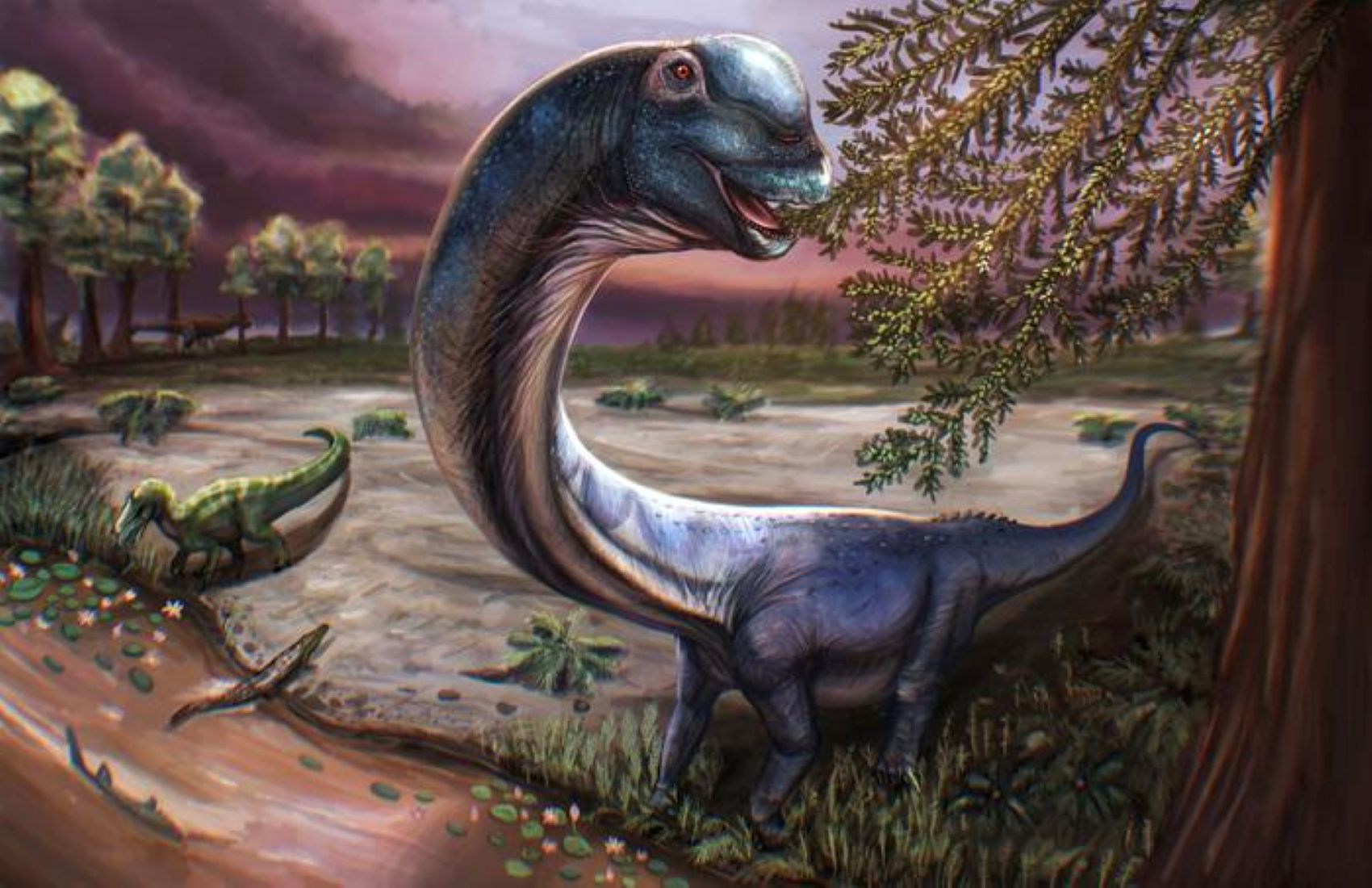
Ten years ago, bones unearthed at the edge of a pond in northeastern Thailand hinted at something extraordinary. Now, researchers from University College London (UCL), Mahasarakham University, Suranaree University of Technology, and the Sirindhorn Museum have revealed the find: a new species of long‑necked plant‑eating dinosaur, the largest ever discovered in Southeast Asia.
Named Nagatitan chaiyaphumensis, the creature stretched 27 meters from nose to tail and weighed about 27 tonnes, roughly the same as nine adult Asian elephants. Its front leg bone alone measured 1.78 meters, as long as a human.
The name blends myth and geography: “Naga” for the serpent of Southeast Asian folklore, “Titan” for the giants of Greek mythology, and “chaiyaphumensis” for the Thai province where the fossils were found. It is the 14th dinosaur named in Thailand.
Lead author Thitiwoot (Perth) Sethapanichsakul, a Thai PhD student at UCL Earth Sciences, said: “Our dinosaur is big by most people’s standards; it likely weighed at least 10 tonnes more than Dippy the Diplodocus (Diplodocus carnegii). However, it is still dwarfed by sauropods such as Patagotitan (60 tonnes) and Ruyangosaurus (50 tonnes). We refer to Nagatitan as ‘the last titan’ of Thailand. That is because it was discovered in Thailand’s youngest dinosaur‑bearing rock formation… So this may be the last or most recent large sauropod we will find in Southeast Asia.”
Nagatitan lived 100–120 million years ago in an arid to semi‑arid landscape crisscrossed by rivers. Fossil evidence suggests it shared its world with crocodiles, freshwater sharks, fish, flying pterosaurs, and other dinosaurs, both plant‑eaters like iguanodontians and ceratopsians, and predators such as spinosaurids.
The species belongs to the somphospondylan sauropods, a subgroup that spread widely about 120 million years ago. More specifically, it falls within the Euhelopodidae, a group found only in Asia. Distinctive features in its spine, pelvis, and legs set Nagatitan apart from other sauropods.
Sethapanichsakul reflected: “My dream is to continue pushing to get Southeast Asian dinosaurs recognized internationally… We have a large collection of sauropod fossils that have not yet been formally described; these may include several new species. I’ve always been a dinosaur kid. This study doesn’t just establish a new species but also fulfills a childhood promise of naming a dinosaur.”
Professor Paul Upchurch of UCL added: “This discovery comes out of a new collaboration between UCL and colleagues in Thailand… 3D scanning and printing have enabled us to study the specimen and collect data without traveling (which reduces the carbon footprint). It is great to work with Thai colleagues and start to get insights into what was happening in Southeast Asia during the Jurassic and Cretaceous.”
Dr Sita Manitkoon of Mahasarakham University, project leader and National Geographic Explorer, highlighted Thailand’s growing role in paleontology: “Although Thailand is a small country within Asia, we have a very high diversity in dinosaur fossils, possibly the third most abundant in Asia… Already, we have a surge of younger generation paleontologists, who are actively undertaking research and promoting paleontology and its importance within the country.”
A life‑size reconstruction of Nagatitan is now on display at the Thainosaur Museum in Bangkok, where visitors can stand beneath the towering “last titan” and imagine the ancient rivers where it once roamed.