Jupiter Through Infrared Eyes: A Planet You’ve Never Truly Seen Before
Introduction
Have you ever wondered what Jupiter would look like if you could see beyond the colors our eyes know? Welcome to FreeAstroScience.com, where we turn the universe’s most complex wonders into stories you can understand. Here, we believe that keeping your mind active is the best way to keep the monsters of ignorance at bay—because the sleep of reason breeds monsters.
Today, we’re taking you on a journey to Jupiter, but not the Jupiter you think you know. Thanks to the James Webb Space Telescope (JWST), we’ve seen the giant planet in a whole new light—literally. The familiar stripes, the legendary Great Red Spot, and the planet’s glowing poles all look different when seen in infrared. If you want to know why Jupiter’s most famous storm turns white, or how its auroras outshine anything on Earth, stick with us to the end. You’ll never look at Jupiter—or science—the same way again.
Table of Contents
- What Did JWST Actually Photograph — and When?
- Why Does Jupiter Look So Different in Infrared?
- Jupiter’s Atmospheric Bands: Stripes of a Living Planet
- The Great Red Spot: Why Is It White in Infrared?
- Jupiter’s Polar Auroras: The Largest Light Show in the Solar System
- JWST vs. Hubble vs. Spitzer: A New Era in Planetary Science
- The Deeper Lesson: How Wavelength Changes Everything We See
- Conclusion
- References
What Did JWST Actually Photograph — and When?
Let’s start with the facts. The James Webb Space Telescope’s first big date with Jupiter was July 27, 2022. This wasn’t just a random snapshot—it was part of the Early Release Science program #1373, led by Professor Imke de Pater from UC Berkeley and Dr. Thierry Fouchet from Paris Observatory. The main tool? JWST’s Near-Infrared Camera (NIRCam), which sees light from 0.6 to 5 microns—way beyond what our eyes can handle.
JWST used three special filters: F360M (3.6 μm), F212N (2.12 μm), and F164N (1.64 μm). Each filter peeks at a different slice of Jupiter’s atmosphere. When the images were processed, red was assigned to F360M, green to F212N, and blue to F164N. That’s how we get those stunning, otherworldly colors.
JWST didn’t stop there. On December 25, 2023, it turned its gaze to Jupiter’s auroras, using the F335M filter (3.36 μm) to catch the glow of H3+—a molecule that lights up the planet’s poles. The Mid-Infrared Instrument (MIRI) also joined in, mapping Jupiter’s heat from 5 to 28.8 microns.
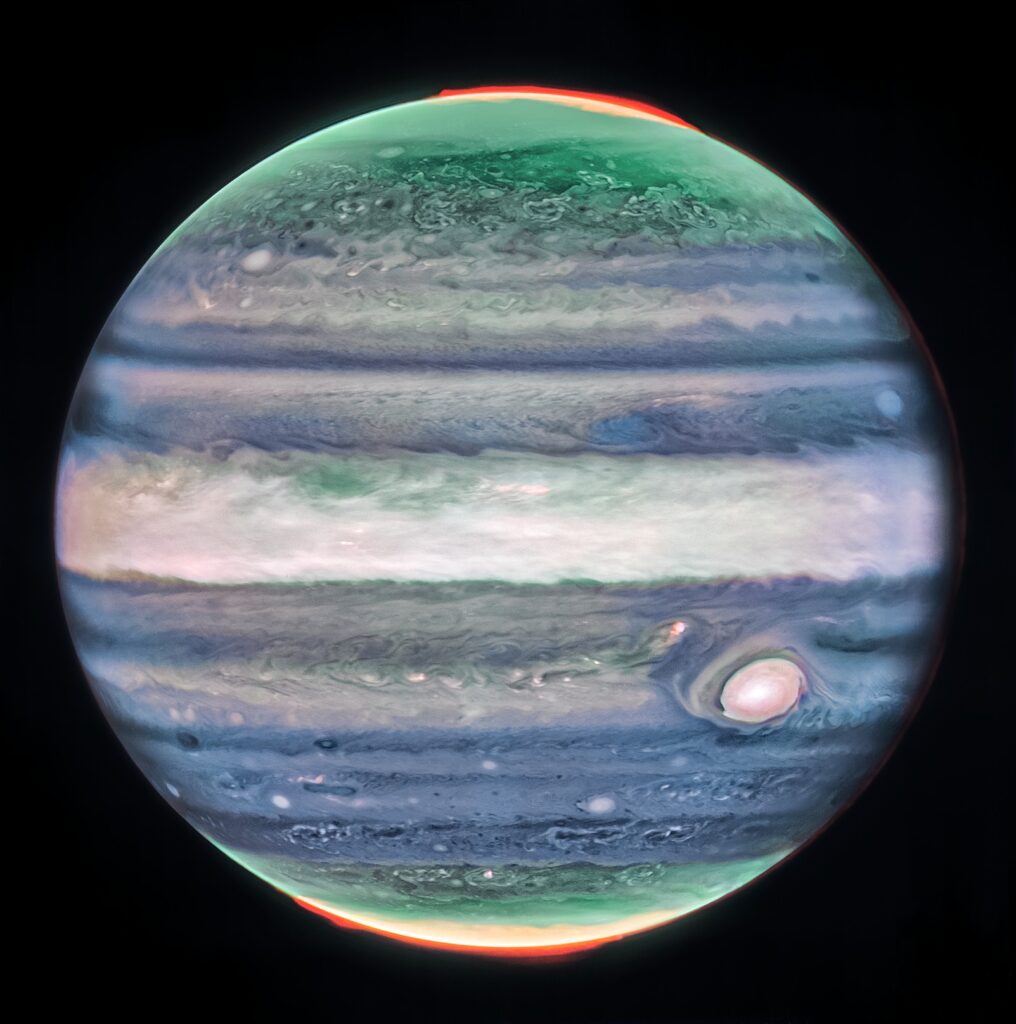
The result? A set of images that changed how we see the Solar System’s giant. Credit goes to NASA, ESA, CSA, STScI, and the image processing wizards Ricardo Hueso and Judy Schmidt.
Why Does Jupiter Look So Different in Infrared?
The Science of False Color Imaging
JWST doesn’t see the world the way we do. Its eyes are tuned to wavelengths from 0.6 to 28.8 microns—far beyond the reds and blues we know. To make sense of this invisible light, scientists use “false color” imaging. They assign visible colors to different infrared wavelengths: longer wavelengths become reds and oranges, shorter ones become blues and greens.
So, when you see orange auroras or a white Great Red Spot in a JWST Jupiter image, remember: those aren’t Jupiter’s “real” colors. They’re a map of heat, chemistry, and altitude, translated into something our brains can process.
Reflected Light vs. Thermal Emission
In visible light, Jupiter shines by reflecting sunlight off its cloud tops. That’s the Jupiter you see through a backyard telescope. But in the near-infrared, JWST picks up both reflected sunlight and the planet’s own heat. Move into the mid-infrared, and it’s all about thermal emission—heat radiating from deep inside Jupiter.
Here’s the twist: thick, cold clouds block heat from escaping, so they look bright in infrared. Cloud-free “hot spots” let heat out, so they appear dark. It’s like looking at a campfire through a thermal camera—what’s hot and what’s cold gets flipped on its head.
Jupiter’s Atmospheric Bands: Stripes of a Living Planet
Jupiter’s stripes aren’t just for show. These horizontal bands—called zones (light) and belts (dark)—are the result of fierce jet streams and shifting chemistry. The planet spins once every 10 hours, faster than any other planet. That rapid rotation whips the atmosphere into bands that stretch around the globe.
In infrared, these bands reveal secrets you can’t see in visible light. Temperature differences, cloud thickness, and chemical gradients all pop out. JWST’s sharp vision can spot features just a few hundred kilometers wide—think of it as seeing the difference between a city and a small town from millions of kilometers away.
The Great Red Spot: Why Is It White in Infrared?
A Storm Bigger Than Earth — and Still Shrinking
The Great Red Spot (GRS) is the king of storms. In the late 1800s, it stretched 41,000 km across. By Voyager 1’s flyby in 1979, it had shrunk to 23,300 km. Hubble measured it at 20,950 km in 1995, 17,910 km in 2009, and now, in 2023–2024, it’s about 16,000 km wide. That’s still big enough to swallow Earth whole, but it’s shrinking—about 930 km per year since 2012.
The storm’s shape is changing, too. It’s becoming more circular, less like a stretched-out oval. Winds at the outer ring now top 640 km/h (400 mph), up 8% since 2009. And thanks to Hubble’s 2023–2024 campaign, we know the GRS “jiggles” in 90-day cycles, squeezing and stretching as it drifts across Jupiter’s face. JWST’s MIRI mapped the GRS in July–August 2022, capturing its heat signature in detail.
The Chemistry of Red: What Makes the Great Red Spot Red?
So, why is the GRS red in the first place? The answer is chemistry. The “crème brûlée” model says there’s a thin layer of chromophores—complex molecules formed when ammonia (NH3) and acetylene (C2H2) react under ultraviolet sunlight—sitting at about 0.1–0.2 bar pressure. These chromophores absorb blue and UV light, reflecting red. Lab experiments have even recreated this reddish material.
Why Does the Great Red Spot Appear White in Infrared?
Here’s the kicker: in infrared, those chromophores don’t matter. Infrared light tells us about temperature and cloud thickness, not color. The GRS has thick, cold, high-altitude clouds at its center. These clouds block heat from below, making the spot look bright—almost white—in infrared. The surrounding areas, with thinner clouds, let more heat escape and look darker.
JWST found a cold center, a warm ring around it, and a mix of aerosols and phosphine (PH3) throughout. Above the GRS, JWST spotted stratospheric hot spots—probably waves generated deep in the storm. There are even north-south differences in temperature and chemistry.
GRS Appearance at Different Wavelengths
| Wavelength | What’s Detected | Color Appearance | Atmospheric Layer Probed | Key Features Revealed |
|---|---|---|---|---|
| Visible Light (0.4–0.7 μm) | Reflected sunlight, chromophores | Brick-red | Upper cloud tops | Chromophore layer, storm shape |
| Near-Infrared (1–5 μm) | Reflected sunlight + thermal emission | Whitish or pale | Cloud tops & upper troposphere | Cloud thickness, temperature, aerosols |
| Mid-Infrared (5–28 μm) | Thermal emission only | Bright white (cold center) | Deeper atmospheric layers | Thermal structure, hot spots, wind shear |
Jupiter’s Polar Auroras: The Largest Light Show in the Solar System
What Causes Jupiter’s Auroras?
Jupiter’s auroras are the most powerful in the Solar System. They’re not just a solar wind story. Jupiter’s magnetic field is 14 times stronger than Earth’s. It grabs charged particles from two places: the solar wind and Io’s volcanic eruptions. Io spits out about 1,000 kg of sulfur and oxygen ions every second, forming a plasma torus around Jupiter. The planet’s magnetic field sweeps this up and funnels it to the poles, where it slams into the atmosphere and lights up the sky.
Unlike Earth’s auroras, which come and go with solar storms, Jupiter’s are almost always on—thanks to this double power source.
Why Do the Auroras Glow Orange in JWST Images?
The secret is H3+ (trihydrogen cation). When energetic electrons hit Jupiter’s upper atmosphere, they ionize molecular hydrogen (H2), creating H3+. This molecule radiates strongly in the 3–4 micron infrared range. JWST’s NIRCam F335M filter (3.18–3.54 μm) is tuned to catch this glow. In the false-color images, these wavelengths are mapped to orange or red, making the auroras blaze at both poles.
How Big and Powerful Are Jupiter’s Auroras Compared to Earth’s?
Jupiter’s auroras are monsters. They stretch over 10,000 km—big enough to swallow Earth several times. They reach up to 3,000 km above the clouds. The Dusk Active Region (DAR) shines at 170 ± 30 μW m⁻² sr⁻¹ in infrared. Earth’s auroras rarely top a few μW m⁻² sr⁻¹. A single flare on Jupiter can dump 55 terajoules of energy, with 0.9 TJ radiated by H3+ in just 10 minutes. Rapid Eastward-traveling Auroral Pulses (REAPs) zip along at 60–67 km/s—15–20 times Jupiter’s rotation speed—with a beat of about 1.6 minutes.
Jupiter vs. Earth Auroras: Quick Comparison
| Feature | Jupiter | Earth |
|---|---|---|
| Size | 10,000+ km diameter | Few thousand km |
| Energy Output | 55 TJ per flare | ~0.1 TJ per event |
| Primary Driver | Solar wind + Io plasma | Solar wind only |
| Persistence | Nearly continuous | Intermittent |
| Infrared Brightness | 170 μW m⁻² sr⁻¹ (DAR) | Few μW m⁻² sr⁻¹ |
What Did JWST Discover That Prior Telescopes Couldn’t?
JWST changed the game. It found that Jupiter’s auroras aren’t slow and steady—they “fizz and pop,” changing in seconds, not minutes. The brightest infrared auroral features had no match in Hubble’s ultraviolet images. That means infrared and UV auroras can be driven by different processes.
JWST also gave us the first detailed spectra of Io’s and Europa’s auroral footprints. These are cold spots—538 K compared to 766 K in the surrounding aurora—with ion densities three times higher. These discoveries, published in Nature Communications (May 12, 2025), were led by Dr. Jonathan Nichols from the University of Leicester. As Dr. Nichols put it:
“Webb’s sensitivity and resolution have allowed us to see the auroras in ways we never could before. The variability of the H3+ emission is a real surprise and suggests that Jupiter’s magnetosphere is even more dynamic than we thought.”
JWST vs. Hubble vs. Spitzer: A New Era in Planetary Science
JWST isn’t just another telescope—it’s a leap forward. Let’s see how it stacks up against its famous predecessors.
| Telescope | Mirror Size | Wavelength Range | Spatial Resolution at Jupiter | Key Jupiter Discoveries |
|---|---|---|---|---|
| JWST | 6.5 m | 0.6–28.8 μm | 0.031–0.063 arcsec/pixel | Auroral variability, jet stream, GRS 3D mapping |
| Hubble | 2.4 m | 0.2–2.5 μm | 0.05 arcsec/pixel | Visible/UV auroras, GRS shrinkage, wind speeds |
| Spitzer | 0.85 m | 3–180 μm | ~2 arcsec/pixel | Thermal emission, cloud structure |
JWST’s NIRCam and MIRI instruments let us see features as small as a few hundred kilometers. It discovered a 320 mph (515 km/h) jet stream 25 miles above the cloud tops at 2.12 μm. NIRSpec IFU revealed dark arcs and bright spots above the GRS—evidence of waves moving up from the storm’s depths. MIRI gave us 3D thermal maps. As Professor Imke de Pater said:
“We’ve never seen Jupiter like this before. The level of detail in the cloud bands, the structure of the Great Red Spot, and the clarity of the auroras are simply breathtaking.”
The Deeper Lesson: How Wavelength Changes Everything We See
Here’s the big idea: the universe changes depending on how you look at it. Jupiter’s Great Red Spot turns from brick-red to white. The planet’s orange auroras are invisible in visible light but blaze in infrared. The Pillars of Creation in the Eagle Nebula are opaque in visible, transparent in infrared. The Crab Nebula, the Andromeda Galaxy—every wavelength tells a new story.
Science teaches us not to trust a single perspective. Always look with different eyes. That’s what FreeAstroScience is all about—keeping your mind active, never letting it sleep, because the sleep of reason breeds monsters.
Conclusion
JWST’s infrared images of Jupiter have changed the way we see our Solar System’s giant. We’ve learned that the familiar can become strange, and the strange can become familiar, all by changing the lens through which we look. The Great Red Spot isn’t always red. The planet’s poles glow with energy invisible to our eyes. Every band, every storm, every aurora tells a story—if we’re willing to see it.
So, next time you look up at Jupiter, remember: there’s always more than meets the eye. And if you want to keep your mind sharp, come back to FreeAstroScience.com. We’ll be here, turning science into stories, and stories into understanding.
References
- NASA Science
- ESA Webb
- STScI Webb
- Nature Astronomy 2023: Jet Stream Discovery
- Nature Communications May 12, 2025: Aurora Variability
- University of Leicester: JWST Jupiter Auroras
- NASA Science Visualization Studio
Written for you by FreeAstroScience.com — where science never sleeps, and neither should your curiosity.