
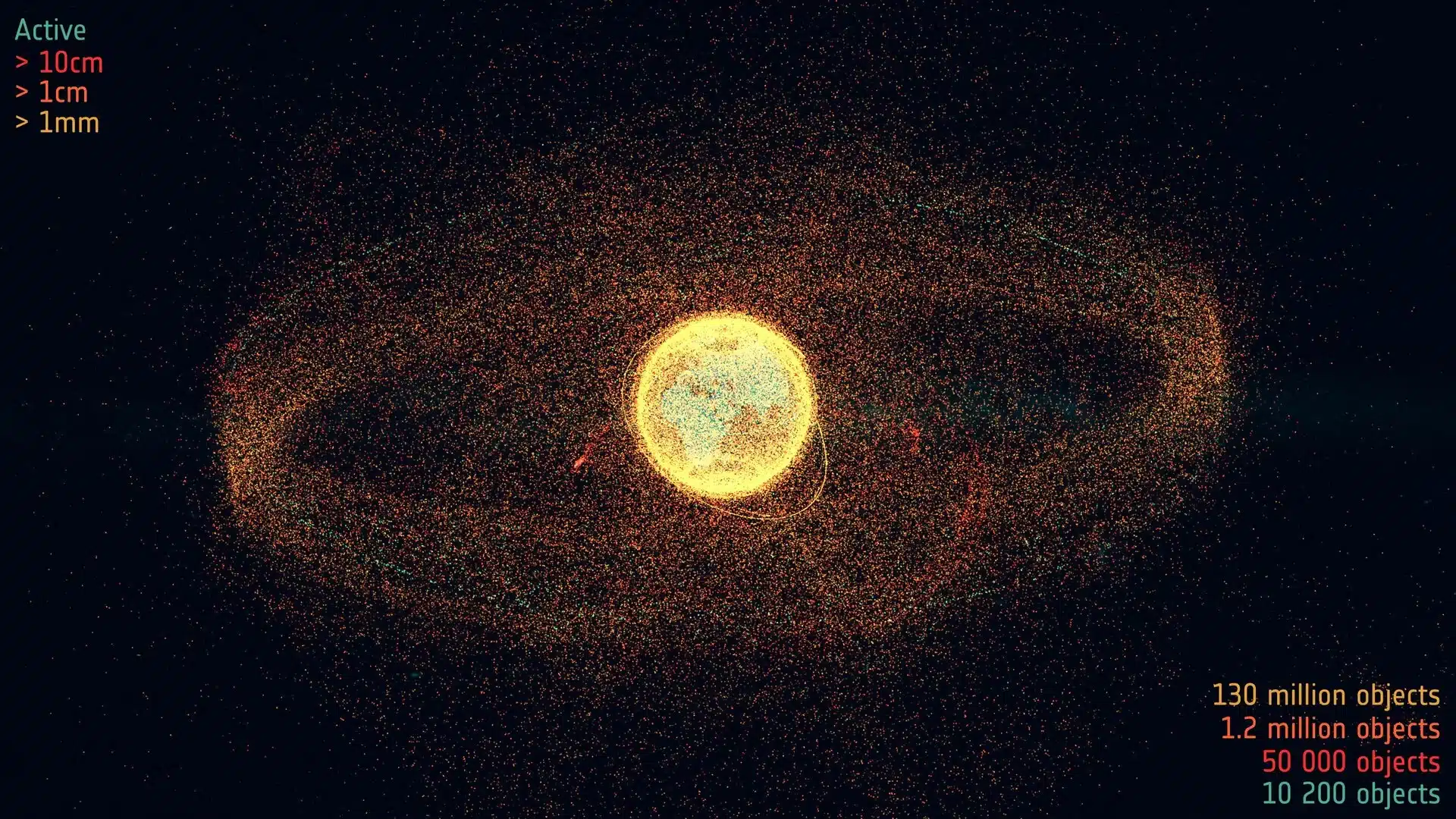
What happens when a fleck of paint, barely bigger than a grain of sand, slams into your billion-dollar satellite at 15 kilometers per second? Welcome, dear reader. We’re glad you’re here with us at FreeAstroScience.com, where we turn heavy science into plain talk you can actually use. Today we walk you through the new material science shielding spacecraft from space junk and cosmic bullets, following a fresh review paper out of the University of Bremen. Stay with us to the end. You’ll leave knowing exactly why engineers lose sleep over 0.2 mm particles, and why 3D printing might be the hero of the next space decade.
The Material Science Behind Spacecraft Impact Armor: A Friendly Guide
Space isn’t empty. It’s a shooting gallery. Every satellite we launch has to survive hits from two distinct enemies: natural micrometeoroids screaming in from deep space, and human-made orbital debris circling our planet at insane speeds . A new review paper by Binkal Kumar Sharma (University of Bremen) and Harshitha Baskar pulls together the current state of the art, and it gives us a clear picture of where armor is heading .
Why Do Spacecraft Need Impact Armor Now?
Here’s the blunt truth. As of November 2024, over 5,500 Starlink and 630 OneWeb satellites already orbit Earth, and Rwanda’s Space Agency has filed with the ITU to place nearly 330,000 more through its Cinnamon constellations. That’s not a typo. Three hundred thirty thousand.
More satellites mean more collisions. More collisions mean more fragments. And every fragment becomes a tiny bullet that can punch through whatever we launch next. Designing armor that’s tough and light has turned into one of the biggest puzzles in modern aerospace engineering .
What’s the Difference Between Meteoroids and Orbital Debris?
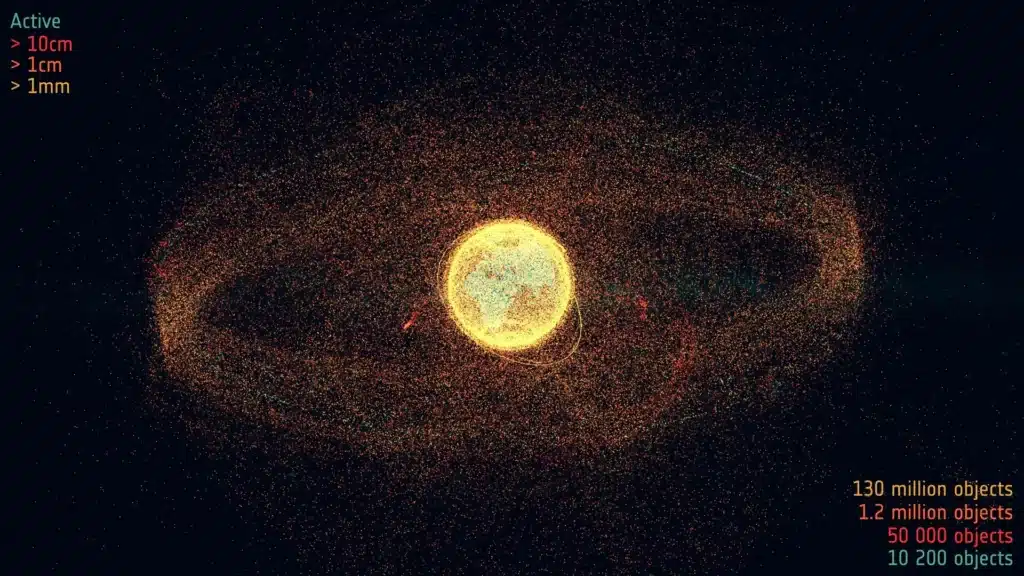
We have to picture two very different opponents. Micrometeoroids are natural rocky or metallic fragments, typically 10 µm to 2 mm across, born from comets and asteroids. They dive toward Earth from outer space, so they almost always arrive from “above,” and they can travel between 11 and 72 km/s .
Orbital debris is a human mess. It’s dead satellites, rocket stages, lost bolts, frozen coolant, even paint flakes. This junk can come from any direction at 1 to 15 km/s, and it clusters most dangerously between 600 and 1,300 km altitude.
Why does speed matter so much? Because kinetic energy scales with velocity squared. A simple formula makes the problem obvious:
A 0.2 mm meteoroid at 23 km/s carries enough energy to punch a 13 mm crater through reinforced shuttle glass.
How Does the Classic Whipple Shield Work?
Fred Whipple proposed it in the 1940s, and it’s still the industry backbone . The idea is almost poetic: put a thin, sacrificial aluminum plate away from what you want to protect. When a projectile hits the bumper, the impact is so violent that the particle and the bumper both vaporize into an expanding cloud of tiny fragments. By the time that cloud reaches the rear wall, its energy is spread across a much bigger area. The spacecraft lives .
What Upgrades Followed the Original Design?
Stuffed Whipple Shield
NASA and ESA developed this version for the U.S. Laboratory and Columbus modules on the ISS. Engineers stuffed the gap between bumper and rear wall with layers of Kevlar aramid fabric and Nextel ceramic cloth. These fabrics keep pulverizing the debris cloud, weakening any fragment that makes it through.
Multi-Shock Shield
This design stacks several Nextel layers at specific standoff distances. Each layer shocks the projectile again, breaking it into smaller and smaller pieces until whatever arrives at the rear wall is basically dust .
Mesh Double Bumper and Foam Panels
Mesh aluminum bumpers give good shock-to-weight ratios. Foam Core Sandwich Panels (FCSP) avoid the “channeling effect” that hurts classic honeycomb panels, where debris slips through hexagonal cells without being properly dispersed .
Can 3D Printing Really Cut Shield Weight by 70%?
Yes, and that number is why engineers are paying attention. The technique is called Laser Powder Bed Fusion (LPBF), a type of metal 3D printing where a laser melts metallic powder layer by layer. Estimates put weight savings from LPBF parts at up to 70% compared to traditionally machined components .
In space, weight equals cost. Every kilogram you shave off a shield is a kilogram you can give to science instruments, propellant, or payload. That’s a massive win.
There’s a catch, though. Current LPBF parts tend to be porous and don’t yet match the rigid mechanical properties of machined metal. In an environment where “shock” is the whole design philosophy, those tiny internal holes are a risk . So researchers took the concept one step further: they designed 3D-printed metal lattices, open honeycomb-like skeletons that fragment projectiles while keeping mass minimal .
Why Is UHMWPE the New Star Material?
Between the layers of that 3D-printed metal lattice, engineers now slot sheets of Ultra-High Molecular Weight Polyethylene, or UHMWPE. Picture it as a kinetic sponge. Once the lattice shatters the projectile, UHMWPE soaks up the leftover energy of the fragments .
There’s a bonus. Mix UHMWPE with additives like natural graphene flakes and boron carbide, and suddenly your armor also protects against heat and radiation . One shield, three jobs. That’s the kind of multifunctional design modern missions dream about.
What Does Real Impact Damage Look Like?
We don’t have to imagine. The Space Shuttle kept bringing back the evidence.
- STS-126 window damage: a meteoroid roughly 0.2 mm in size, made of magnesium and silicon oxide, hit Window No. 6 at 23 km/s. It carved a crater 13.43 mm × 8.97 mm, with a depth of 0.83 mm — the largest shuttle window impact ever recorded .
- STS-118 radiator strike: a 1.6 mm orbital debris particle, moving around 9 km/s, punched a 6 mm hole clean through Left-Hand Radiator No. 4 and into the payload bay door structure .
Those aren’t theoretical numbers. They’re scars on returned hardware. Now imagine the same energy hitting a human-rated capsule without the right shielding.
Are We Sliding Toward Kessler Syndrome?
Donald Kessler warned us back in 1978. His idea was simple and terrifying: if orbital density climbs too high, a single collision triggers a cascade. Those fragments hit other satellites, which create more fragments, which hit more satellites. Some researchers argue that Low Earth Orbit between 900 and 1,000 km may already be at the tipping point .
A 2010 study estimated that space debris could cut the operational life of large LEO satellites by about 13% over 50 years. Newer projections, factoring in the 5,000+ new small satellites being deployed, double that figure. In extreme cases, solar panel degradation alone could slash useful life by 60% .
Good armor isn’t just about protecting one mission. It’s about keeping space usable for the next generation. That’s why Sharma and Baskar’s review matters beyond engineering journals — it touches the sustainability of everything we do above the atmosphere .
Closing Thoughts
We’ve walked together through a strange and beautiful problem. Spacecraft armor has evolved from a single aluminum plate into layered systems of 3D-printed metal lattices, ceramic fabrics, and kinetic-sponge polymers enhanced with graphene. Each generation gets lighter, smarter, and more multifunctional. That’s the pattern of good engineering: doing more with less, while keeping humans and hardware safe in the harshest environment we know.
But here’s the quiet question we want to leave with you. If our orbits keep filling up with satellites faster than we can deorbit them, no shield in the world can save every mission. Armor buys us time. Responsibility buys us a future.
This article was written specifically for you by FreeAstroScience.com, where we translate complex scientific principles into simple terms. We believe you should never switch off your mind, because the sleep of reason breeds monsters. Come back soon — there’s always more sky to understand, and we’d love to keep exploring it with you.
📚 Sources & Further Reading
- Tomaswick, A. (2026, May 8). The Material Science Behind A Spacecraft’s Impact Armor. Universe Today.
- Sharma, B. K., & Baskar, H. (2025). Space Environment and Debris: A Review of Micro-Meteoroids and Orbital Debris Impact Protection. University of Bremen.
- NASA Orbital Debris Program Office — Official Data Portal
- ESA Space Debris Office — ESA Annual Report (2024)
- NASA Standard 6016B — Materials Standards for Spacecraft Design