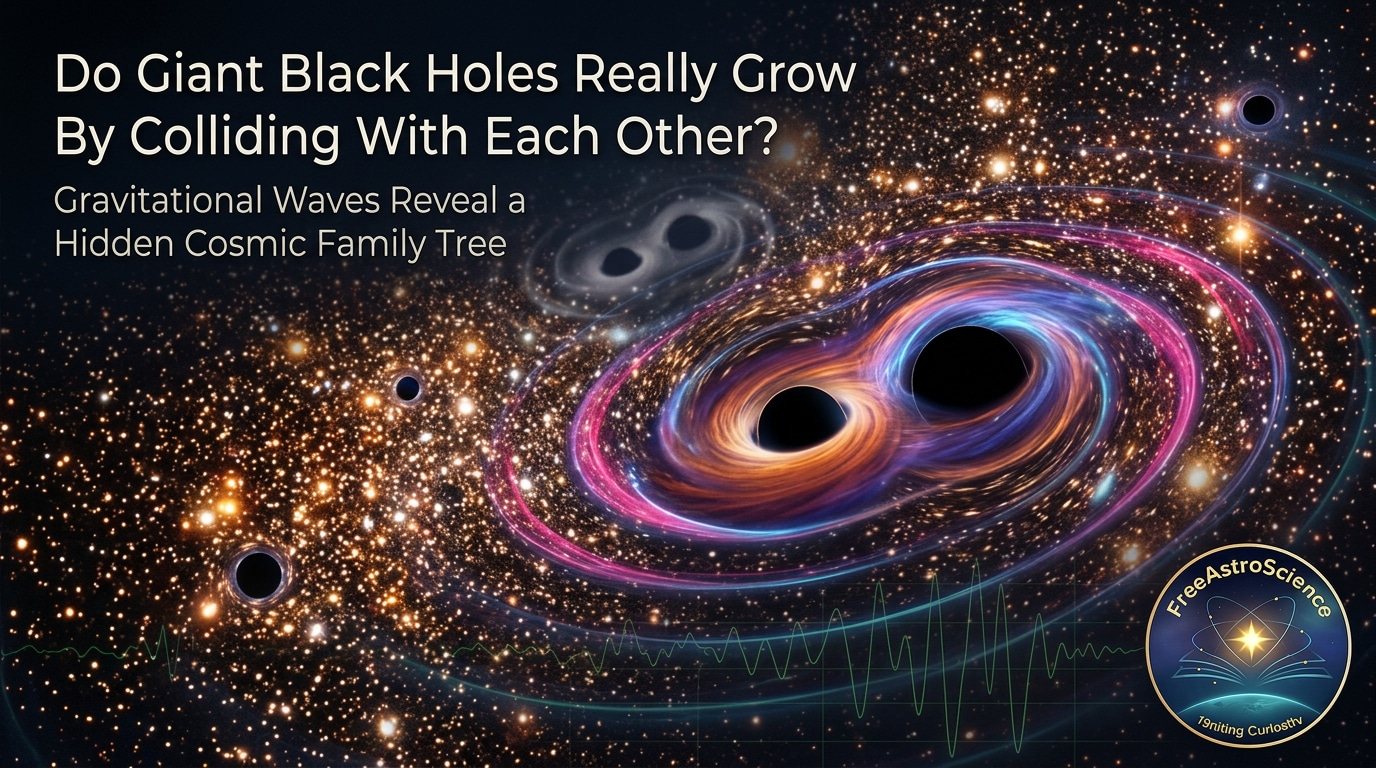
Do Giant Black Holes Really Grow By Colliding With Each Other?
Have you ever wondered how the universe builds its heaviest monsters? What if the biggest black holes we detect weren’t born big at all, but grew through a violent history of cosmic collisions?
Welcome, dear reader. We’re glad you landed on FreeAstroScience, the home where we break down hard science into plain words. Today we’ll walk you through a breakthrough published in Nature Astronomy on April 2026, one that reshapes what we thought we knew about black holes. Stay with us to the end. This story ties together gravity, nuclear physics, and the chaotic hearts of ancient star clusters, and we promise it’s worth every scroll.
📚 Table of Contents
- What did LIGO, Virgo and KAGRA just find?
- Why should a “mass gap” exist at all?
- How do we tell two black hole families apart?
- Why do globular clusters change the game?
- Can gravitational waves measure nuclear reactions?
- What do the key numbers tell us?
- Where does this discovery take us next?
What did LIGO, Virgo and KAGRA just find?
A team led by Fabio Antonini at Cardiff University sifted through 153 binary black hole mergers recorded in the fourth Gravitational-Wave Transient Catalogue (GWTC-4) . That’s more than twice the sample size used for earlier studies, and it changes everything.
Their result is striking. The data split cleanly into two populations of black holes, with a sharp boundary sitting at 44.3 solar masses . Below that line, black holes spin slowly and quietly. Above it, they spin fast and tumble in random directions, like ice skaters pushed by invisible hands.
Published in Nature Astronomy (DOI: 10.1038/s41550-026-02847-0), the work uses ripples in spacetime first predicted by Einstein in 1915 to peer into places no telescope can reach.
Why should a “mass gap” exist at all?
Here’s where physics gets dramatic. When a star’s core grows past roughly 40 solar masses of helium, something wild happens inside it. Photons become so energetic that they spontaneously convert into electron-positron pairs. This drains pressure from the core, and the star collapses partway, triggering violent pulsations.
For helium cores between about 40 and 65 solar masses, the star blasts off huge chunks of material. Above 65 solar masses, the whole star shreds itself apart, leaving nothing behind . No black hole. No remnant. Just light and debris.
This is the pair-instability supernova, and it carves out what astronomers call a forbidden zone roughly between 40 and 130 solar masses where stellar collapse shouldn’t be able to make a black hole at all .
So why are we finding black holes inside that zone?
That’s the puzzle. We keep detecting them. GW190521 was the famous first case, but now dozens more sit squarely inside the supposed gap .
How do we tell two black hole families apart?
The trick is looking at how fast these black holes spin. Physicists use a quantity called the effective spin parameter (χ_eff), which measures how the two black holes’ rotations line up with their orbit.
| Feature | Population Below 45 M☉ | Population Above 45 M☉ |
|---|---|---|
| Spin size | Tiny (μ ≈ 0.04) | Large, up to χ_eff ≈ 0.49 |
| Spin direction | Aligned with orbit | Random, isotropic |
| Likely origin | Direct stellar collapse | Repeated mergers |
| Number of events | 119 sources | 34 sources above 45 M☉ |
| Bayes factor | B > 10⁴ favoring the two-population model | |
A Bayes factor greater than 10,000 isn’t just “suggestive.” It’s statistical proof with a capital P.
What does an isotropic spin really mean?
Picture two black holes formed together from two stars that orbit each other. Their spins tend to point the same way, because they share a common birth. Now picture a black hole that formed from a previous merger, wandering through a crowded star cluster, bumping into another compact object at a random angle. Their spins have no reason to align.
That’s why random orientations are a fingerprint of a hierarchical merger, a black hole built from smaller black holes over time .
Why do globular clusters change the game?
Globular clusters are ancient balls of hundreds of thousands of stars packed into a space just a few light-years across. Imagine Manhattan if every building held a star and they were all playing bumper cars. These places are gravitational madhouses.
In such dense regions, when two black holes merge, the remnant doesn’t fly off into empty space. It sticks around and can bump into another black hole. Then another. Then another.
Antonini’s team calculated that if the heavy black holes we see really come from this process, the clusters where they grew must have initial densities of at least 10⁴ solar masses per cubic parsec . That’s a ridiculous density, but globular clusters deliver it.
What about general relativity’s universal spin?
Here’s a beautiful prediction. When two black holes of roughly equal mass merge, the newborn black hole always spins at about 70% of its maximum possible rate. This is a result from general relativity that’s essentially independent of the parent masses .
That universal spin leaves a mathematical fingerprint on χ_eff, which can be written as:
|χeff| ≤ mrem · arem mrem + m2 with arem ≈ 0.7
Run through the math for typical secondary masses, and you get |χ_eff| ≲ 0.47. The data show an upper bound right around 0.5 . The prediction matches the observation almost perfectly. If that isn’t beautiful, I don’t know what is.
Can gravitational waves measure nuclear reactions?
This is the part that blew my mind as I read the paper. The exact location of the pair-instability gap depends on how carbon turns into oxygen inside a star’s helium-burning core. That’s the famous ¹²C(α, γ)¹⁶O reaction, one of the most important and least well-measured reactions in all of nuclear astrophysics .
A faster reaction rate means more oxygen, leaner carbon, and pair instability kicking in at lower masses. A slower rate pushes the whole gap higher.
By pinning down where the gap starts from gravitational waves, the team derived the astrophysical S-factor at 300 keV:
S₃₀₀ = 268+195−116 keV · b (90% credibility)
That’s a measurement of a nuclear reaction rate obtained from colliding black holes. Let that sink in. We used the echoes of dead stars to measure the nuclear furnace that built them.
What do the key numbers tell us?
Let me pull together the most important figures from the study:
| Measurement | Value | What it means |
|---|---|---|
| Transition mass (m̃) | 44.3 +5.9−3.5 M☉ | Lower edge of the forbidden zone |
| Sample size | 153 mergers | Double the previous catalogue |
| Events above 45 M☉ | 34 | Enough to rule out statistical flukes |
| Merger rate at z=0.2 | 33.4 Gpc⁻³ yr⁻¹ | How often these events happen |
| Peaks in mass spectrum | 10, 18, 38 M☉ | Features in the population |
| Misaligned spin evidence | 98.4% credibility | Random orientations are real |
There’s also what the authors call “the cliff”: a drop of nearly two orders of magnitude in the merger rate right at 40 solar masses . You don’t see features that sharp unless nature is putting up a wall.
A second gap at 14 solar masses?
Here’s a tantalizing hint. The team found a possible dip in the rate near 14 M☉, which might be a smaller mass gap also filled by hierarchical mergers . Recent events like GW241011 and GW241110 appear to fit this picture. The signal isn’t statistically required yet, but future catalogues will tell.
Where does this discovery take us next?
Three doors just opened wide.
First, we now have direct evidence that dense stellar environments aren’t a theoretical curiosity. They’re real factories where black holes grow through repeated collisions. The cluster density floor of 10⁴ M☉/pc³ gives us a powerful constraint on how these cities of stars formed in the early universe .
Second, gravitational waves have officially become a nuclear-physics instrument. The ¹²C(α, γ)¹⁶O rate shapes stellar cores, neutron star masses, supernova yields, white dwarf compositions, and even the carbon-to-oxygen ratio in planet-forming disks, which affects whether alien worlds have carbon-rich or oxygen-rich atmospheres . One reaction, and it touches almost everything.
Third, future observing runs will keep sharpening these results. As the catalogue grows, the uncertainty on the gap edge will shrink, tightening the nuclear constraint along with it.
Final Thoughts
This article was written for you by FreeAstroScience.com, where we take hard principles and translate them so nobody gets left behind. Our mission is simple: we want you to never switch off your mind, because the sleep of reason breeds monsters.
Think about what this study actually says. The heaviest black holes we detect weren’t born that way. They grew through a violent family tree of mergers inside the densest corners of the cosmos. Each merger left behind a bigger child, and that child went on to collide again. Generation after generation, in the crowded hearts of globular clusters, nature built giants from rubble.
And then, using nothing but tiny spacetime wiggles crossing Earth, we pulled apart that history, measured a nuclear reaction rate that shapes stellar cores, and drew a line at 44 solar masses where the laws of pair instability begin to bite.
That’s the power of thinking carefully, measuring patiently, and refusing to accept the first easy answer. Come back soon to FreeAstroScience. There’s so much more of the universe waiting for us to understand together.
📖 References
- Antonini, F., Romero-Shaw, I. M., Callister, T., et al. “Gravitational-wave constraints on the pair-instability mass gap and nuclear burning in massive stars.” Nature Astronomy (2026). DOI: 10.1038/s41550-026-02847-0
- Retemedia. “I più grandi buchi neri dell’universo potrebbero nascere in ambienti stellari caotici.” 8 May 2026
- LIGO–Virgo–KAGRA Collaboration. “GWTC-4.0: updating the Gravitational-Wave Transient Catalog.” arXiv:2508.18082
- Code repository: github.com/antoninifabio/spin-study-in-O4a
- Data release: Zenodo 10.5281/zenodo.17148536