Why Can’t We Measure the Gravitational Constant G? The Universe’s Most Frustrating Number
Have you ever wondered why, after centuries of science, we still don’t know exactly how strong gravity is? Welcome to FreeAstroScience, where we break down the universe’s toughest puzzles in plain English. Today, we’re diving into the story of “G”—the gravitational constant that holds the cosmos together, yet slips through our fingers every time we try to pin it down. Stick with us to the end, and you’ll see why this number is the most stubborn mystery in all of physics—and why it matters to every one of us.
The Mystery of G: Why the Universe’s Most Important Number Refuses to Be Measured
What Is the Gravitational Constant G, and Why Should We Care?
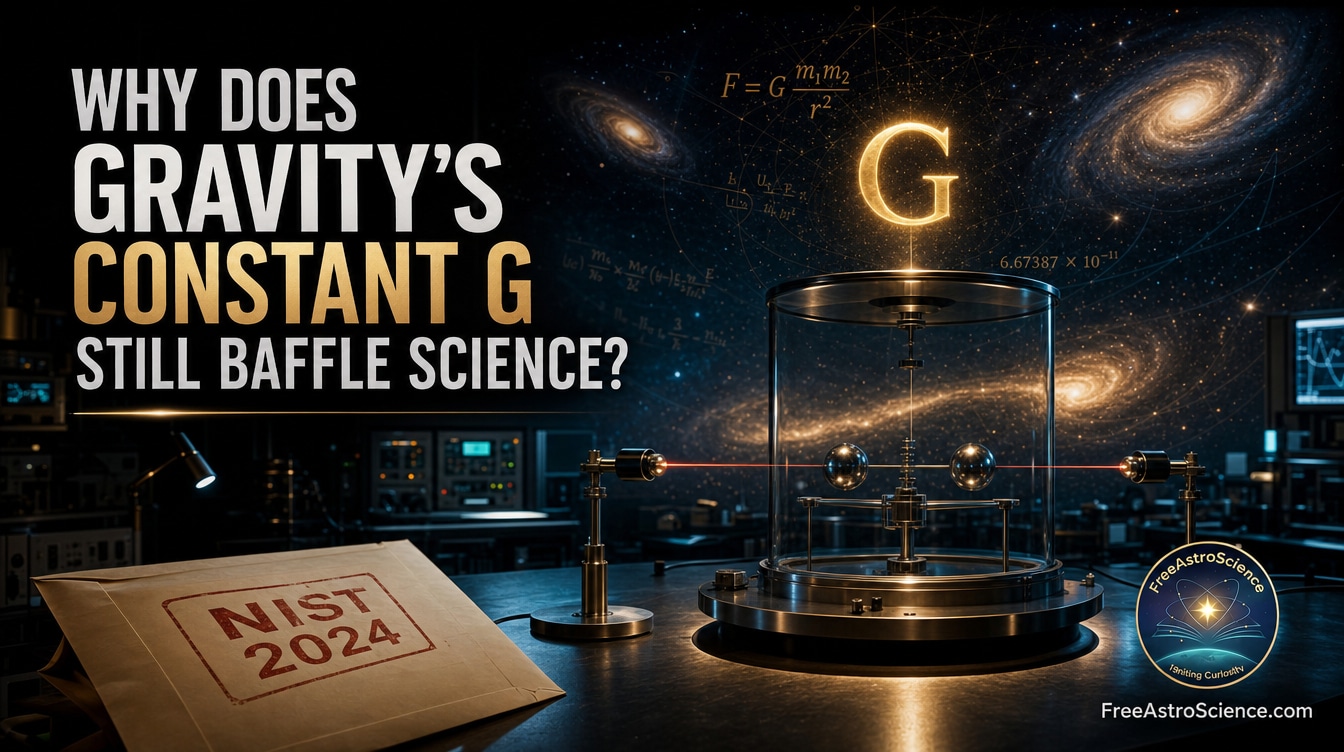
Let’s start with the basics. The gravitational constant, known as “G,” is the number that tells us how strong gravity is everywhere in the universe. It’s the “glue” in Newton’s famous law of universal gravitation:
F = G · m1 · m2 / r2
Here, F is the force between two masses (m₁ and m₂), r is the distance between them, and G is the constant that sets the strength of gravity. The current best estimate for G is:
G ≈ 6.67430 × 10⁻¹¹ m³·kg⁻¹·s⁻²
But here’s the kicker: we only know G to about five digits. That’s embarrassingly imprecise compared to other constants. The speed of light? Defined exactly. Planck’s constant? Also exact. The fine-structure constant? Known to parts per billion. G? We’re stuck at 22 parts per million, and the world’s best labs can’t agree within ten times that.
Key Takeaway: G is the least precisely known of all the fundamental constants. It’s the number that tells us how gravity works, but it’s also the number we can’t seem to nail down.
How Did We First Try to Measure G? The Story from Newton to Cavendish
Did Newton Ever Measure G?
No, he didn’t. When Isaac Newton wrote his Principia Mathematica in 1687, he gave us the law of universal gravitation, but he never calculated G. Newton worked with ratios and proportionalities. He guessed that Earth’s density was about 5–6 times that of water, which, if you do the math, implies G ≈ (6.7 ± 0.6) × 10⁻¹¹—astonishingly close to today’s value, but he never wrote it down as a constant.
Who Built the First Experiment?
John Michell, an English scientist, designed the torsion balance in 1783. He wanted to measure the tiny force between small lead spheres. Sadly, he died in 1793 before he could finish the job.
How Did Cavendish “Weigh the World”?
Henry Cavendish picked up Michell’s idea and, in 1798, pulled off one of the most legendary experiments in physics. He wasn’t trying to measure G directly. Instead, he wanted to find the density of the Earth. Using a horizontal rod with small lead balls at each end, suspended by a thin wire, he measured the twist caused by the gravitational pull of larger lead spheres placed nearby. The forces involved? Just 1.74 × 10⁻⁷ newtons—about the weight of a mosquito.
Cavendish’s result for Earth’s density was 5.448 ± 0.033 times that of water. When we convert his numbers to modern units, we get G = 6.74 × 10⁻¹¹ m³·kg⁻¹·s⁻²—within 1% of today’s accepted value. Not bad for 18th-century tech!
When Did “G” Become a Constant?
The idea of G as a universal constant didn’t exist in Cavendish’s time. It was Charles Vernon Boys, in the 1890s, who first used the symbol “G” and made it a household name in physics.
Why Is G So Hard to Measure—Even Today?
Is Gravity Really That Weak?
Yes. Gravity is the weakest of the four fundamental forces. The electromagnetic force between two protons is 10³⁶ times stronger than their gravitational pull. That’s a number with 36 zeros! A tiny fridge magnet can lift a paperclip against the entire pull of the Earth. No wonder measuring G is like trying to weigh a feather in a hurricane.
What Makes G Measurements So Tricky?
Gravity can’t be shielded. Unlike electricity, you can’t block gravity with a Faraday cage. Every mass nearby—cars, people, even the Moon—tugs on your experiment.
Environmental noise is everywhere. Vibrations, seismic activity, temperature swings, and even passing trucks can swamp the tiny signal you’re trying to measure.
The masses used are tiny. The objects in these experiments are about 500 billion trillion times lighter than Earth.
The torsion balance is both brilliant and flawed. It’s sensitive enough to detect minuscule forces, but it’s also a magnet for systematic errors: fiber anelasticity (up to 200 ppm), thermal noise, electrostatic and magnetic interference, density inhomogeneities, and more.
How Does G Compare to Other Constants?
Let’s put it in perspective. The speed of light is defined exactly: 299,792,458 m/s. Planck’s constant is also exact. The fine-structure constant is known to parts per billion. G? We’re stuck at 22 parts per million—4,000 times worse than Planck’s constant before 2019.
Why Do the World’s Best Labs Still Disagree on G?
You’d think that with modern technology, we’d have nailed down G by now. But the world’s top labs keep getting different answers—sometimes by more than ten times their quoted uncertainties. Here’s a look at the numbers:
Lab / Group
Year
Value (×10⁻¹¹ m³·kg⁻¹·s⁻²)
Uncertainty (ppm)
Method
BIPM (France, Terry Quinn)
2001
6.67559
40
Torsion balance (electrostatic compensation)
BIPM (France, Terry Quinn)
2014
6.67554
24
Torsion balance (electrostatic compensation)
HUST (China, Luo Jun)
2018
6.674184 / 6.674484
12
Time-of-swing / Angular acceleration feedback
University of Washington (Eöt-Wash)
2000
6.674255
14
Angular acceleration feedback
JILA (USA)
2010
6.67234
14
Suspended body displacement
LENS (Italy)
2014
6.67191
150
Atom interferometry
PTB (Germany)
1990s
6.7154 (retracted)
—
Beam balance (error: cross-capacitance)
NIST (USA, Schlamminger)
2024
6.67387
—
Torsion balance (blind analysis)
The spread across these experiments is about 500 ppm (0.05%)—ten to forty times larger than the uncertainties claimed by each lab. Even when the same apparatus is shipped across the Atlantic, as with the BIPM’s Mark II torsion balance sent to NIST, the results don’t line up. The NIST team, led by Stephan Schlamminger, spent a decade on their experiment, using eight metal cylinders and a blinding technique to avoid bias. On July 11, 2024, at a conference in Aurora, Colorado, Schlamminger opened a sealed envelope with the result: 6.67387 × 10⁻¹¹—lower than BIPM’s by 0.0235%, about five times the reported uncertainty. And still, the mystery deepened.
Physicist Clive Speake: “Nobody knows how to predict from theory what the actual value of G should be.”
What’s Going Wrong?
Systematic errors are everywhere. Fiber anelasticity, gas-pressure torques, autocollimator non-linearity, and even the shape of the test masses can throw off results. Some labs have found “dark uncertainty”—unknown sources of error that show up as unexplained shifts between measurements.
Is There a Pattern or Periodicity?
In 2015, Anderson and colleagues claimed G measurements oscillated with a 5.9-year cycle, matching changes in Earth’s rotation. But follow-up studies, including one by Schlamminger, showed this was just a statistical fluke.
What Does G Mean for Einstein, Quantum Gravity, and the Fate of the Universe?
How Does G Appear in Einstein’s Equations?
In Einstein’s general relativity, G is the coupling constant that links the curvature of spacetime to the energy and matter within it. The field equations look like this:
Gμν + Λgμν = (8πG / c4) Tμν
Here, Gμν describes spacetime curvature, Tμν is the energy-momentum tensor, and G tells us how much spacetime bends for a given amount of energy. If G were different, the universe itself would be unrecognizable.
Can G Be Derived from Other Constants?
No. G has dimensions (m³·kg⁻¹·s⁻²), so its value depends on our choice of units. There’s no known theory that predicts what G should be. It’s just a “brute fact” about our universe.
What About Quantum Gravity?
Trying to combine gravity with quantum mechanics leads to mathematical headaches—non-renormalizable infinities. At the Planck scale, G combines with Planck’s constant and the speed of light to define the Planck length, where our current theories break down. As physicist Claudia de Rham says, “Understanding G better might lead to a quantum version of gravity, which is necessary to blend gravity into the standard model.”
Is G Fine-Tuned for Life?
If G were much larger, stars would burn out in a flash or the universe would collapse before life could form. If it were much smaller, no galaxies, stars, or planets would exist—just a thin soup of hydrogen. The range of G that allows life is astonishingly narrow—maybe one part in 10⁶⁰. This has sparked debates about the multiverse and the anthropic principle.
Will We Ever Solve the Mystery of G?
The quest continues. New methods—like atom interferometry and dynamic measurements at ETH Zürich—aim for even higher precision. Some dream of space-based experiments, far from Earth’s noisy environment. An international consortium now coordinates labs worldwide, hoping that teamwork will finally crack the code.
But for now, the mystery remains. As Stephan Schlamminger put it, “Why do people climb Mount Everest? Because it’s there. A fundamental constant that’s difficult to measure—just the challenge itself is a call for some people.”
At FreeAstroScience, we believe that wrestling with these mysteries is what keeps science alive. We write for you, the curious mind, because the sleep of reason breeds monsters. Never turn off your mind—keep it active, keep questioning, and keep coming back for more.
What Can We Learn from the Mystery of G?
The gravitational constant G is the universe’s most stubborn number. It’s the key to understanding everything from falling apples to the fate of galaxies, yet it slips through our fingers every time we try to measure it. The story of G is a story of human curiosity, ingenuity, and humility. It reminds us that even the most familiar forces can hide deep secrets. As we keep searching for answers, let’s remember: the journey is just as important as the destination.
Thanks for reading. Come back to FreeAstroScience.com to keep your mind sharp and your curiosity alive.