Have You Ever Wondered Why No Two Sports Balls Look Alike?
Welcome, dear reader. Grab a coffee, settle in, and join us on a short trip through something you’ve probably held in your hands a hundred times without a second thought: the humble ball.
Why is a rugby ball stretched like an egg? Why does a basketball bounce so much higher than a soccer ball? Why does a volleyball feel almost feather-light when it smacks your forearms? We promise the answers are more fascinating than you’d guess. Stick with us until the end — the physics hidden in these four objects tells a story about engineering, human bodies, and centuries of sport .
📚 Table of Contents
- The Soccer Ball — A Near-Perfect Sphere
- The Basketball — Built to Bounce
- The Rugby Ball — Shaped Like an Egg on Purpose
- The Volleyball — Light Enough Not to Hurt
- Side-by-Side Specs: All Four Balls
- Final Thoughts
The Hidden Physics Behind Four Iconic Sports Balls
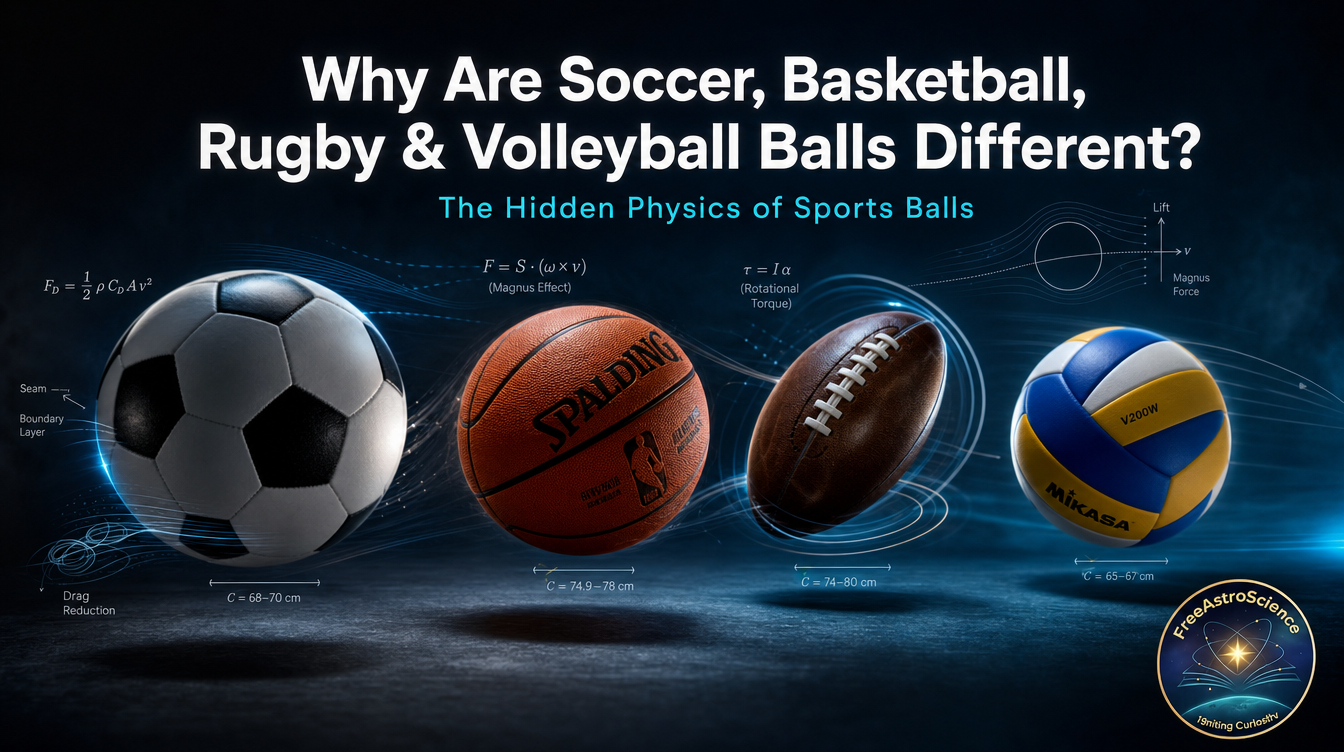
Each ball was born from a problem. Kick it, dribble it, throw it, spike it — every sport asks its ball to do a specific job. The shape, weight, internal pressure and surface texture are engineered answers to those demands .
Let’s walk through them one by one.
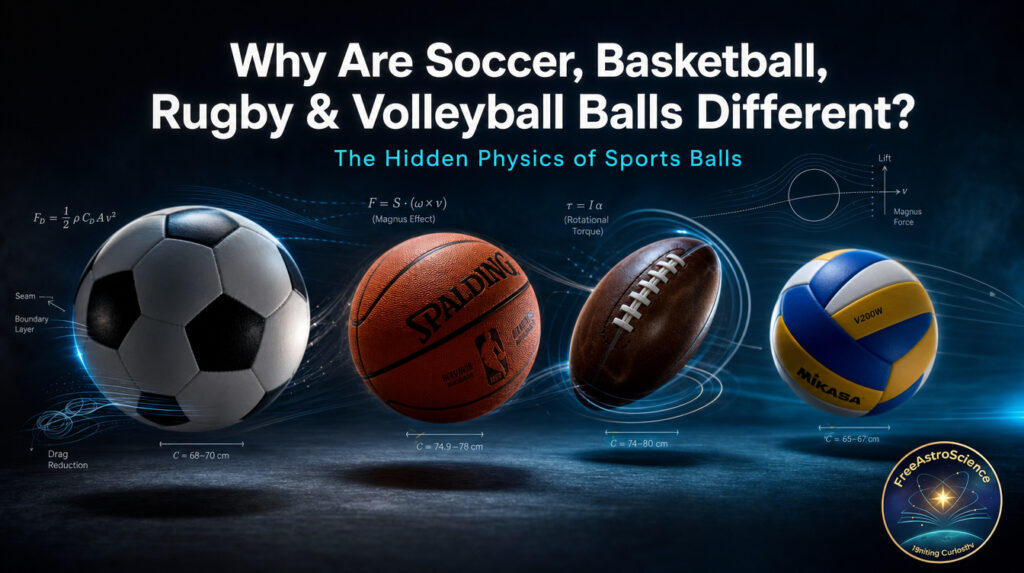
Why Is the Soccer Ball Not a Perfect Sphere?
Here’s a fact that might surprise you: a professional soccer ball isn’t truly round. Rules allow up to a 1.5% deviation from a perfect sphere.
A size 5 ball — the one used in 11-a-side matches — has:
- Circumference: 68–70 cm
- Weight: 410–450 g
- Internal pressure: 0.6–1.1 atmospheres
What’s With All Those Panels?
The classic black-and-white pattern we all grew up drawing in our notebooks comes from a truncated icosahedron — a polyhedron made of 32 faces: 20 hexagons and 12 pentagons .
Modern balls use anywhere from 14 to 26 panels, sometimes shaped like stars or triangles. And no, this isn’t just for looks.
Here’s the clever part: a perfectly smooth ball would create a wide, turbulent wake that slows the ball down and makes it wobble. The seams and grooves create small, controlled turbulences in the thin layer of air hugging the surface. This “roughness effect” keeps air flowing along the ball longer, shrinking the low-pressure zone behind it and giving the ball a faster, more stable flight .
What’s Inside?
Old soccer balls were made of leather. Problem? Leather soaked up water and deformed over time. Today we use polyurethane (PU) or PVC — synthetic, waterproof, shock-absorbing .
Under the skin you’ll find:
- Linings of polyester or cotton that spread impact forces and keep the shape
- Sometimes a foam layer for extra cushioning
- A latex or butyl bladder at the core — the elastic heart that holds pressure and helps the ball snap back into shape after every kick
Why Does a Basketball Bounce So Much Higher?
Strange thing: a basketball has lower internal pressure than a soccer ball (just 0.52–0.58 atm), yet it bounces far better . What gives?
The specs first:
| Version | Circumference | Weight |
|---|---|---|
| Men’s | 75–78 cm | 567–650 g |
| Women’s | 72.4–73.7 cm | 510–567 g |
It’s Not Just the Ball — It’s the Floor
Grass eats energy. When a soccer ball lands on turf, most of the impact energy disappears into the blades and soil. Parquet? That hardwood floor is rigid. It returns almost all the energy back to the ball .
So the real trick lies in where the ball is played, combined with materials built for elasticity. The basketball’s outer shell is stiffer and more elastic than a soccer ball’s. It deforms less, snaps back instantly, and converts the fall into a powerful upward push .
Those Tiny Bumps Aren’t Decorative
Run your fingers over a basketball. Feel those little dots? They increase friction between your hand and the surface — that’s your grip.
Structurally, the ball is built from eight panels of leather or rubber glued to a heavy rubber carcass. Inside, the air bladder is wrapped in hundreds of meters of nylon or polyester thread. That intermediate layer spreads stress across the whole surface and keeps the ball round even after brutal slam dunks .
Why Is the Rugby Ball Shaped Like an Egg?
The rugby ball breaks every “ball” rule. It’s oval, not round. Why?
The numbers:
- Weight: 410–460 g
- Length: 28–30 cm
- Vertical circumference (widest point): 58–62 cm
- Horizontal perimeter (widest point): 74–77 cm
- Pressure: 0.59–0.69 atm
A Shape Born From Pig Bladders
Seriously. The oval shape has historical roots in the use of animal bladders, which naturally stretched into an elongated form when inflated. These were wrapped in leather. When rugby officially split from soccer in the 19th century, players realized something important: even though an oval ball is unstable at the foot, it’s dramatically easier to grip, carry and protect while running .
The Physics of the Spiral Pass
There’s a second reason, and it’s beautiful. When you throw a rugby ball with a spiral — a spin along its horizontal axis — it behaves like a spinning top. The gyroscopic effect stabilizes the flight axis. Air can’t flip the ball. It holds its line all the way to your teammate’s chest .
That’s why a perfect spiral pass looks almost supernatural. Pure physics at work.
Materials and Build
Like a basketball, a rugby ball has a rough, grippy surface. It’s made of four synthetic panels (PU or PVC) stitched internally — leather has been retired for good reasons: synthetics are tougher and waterproof. Inside, an oval bladder sits protected by polyester or cotton layers that spread impact and preserve the ball’s aerodynamic egg shape .
Why Is a Volleyball So Light?
Simple answer: it shouldn’t hurt when it hits you.
A volleyball weighs just 260–280 grams — the lightest of the four . Other specs:
- Circumference: 65–67 cm (slightly smaller than a soccer ball)
- Internal pressure: 0.2–0.3 atm (by far the lowest)
Soft by Design
That low pressure isn’t an oversight — it’s the whole point. A softer ball deforms more on impact, which:
- Spreads the force of the hit across your forearms, making reception less painful
- Increases contact time with your hand, giving you better control over the trajectory
Spiking a brick would destroy your wrist. Spiking a volleyball? Sore, maybe, but playable.
The classic design uses 18 rectangular panels arranged in six groups of three. Modern variants play with fewer panels and different geometries to refine the touch .
Inside the Shell
The outer cover is synthetic — usually PU or PVC, great at absorbing the energy of spikes, sets and digs. The surface has tiny raised dots for grip, similar to a basketball but gentler. Inside, you’ll find the familiar setup: an air bladder surrounded by cotton or polyester layers that keep the ball round and spread external stress .
How Do All Four Balls Compare at a Glance?
We built this quick reference table so you don’t have to scroll back:
| Feature | ⚽ Soccer | 🏀 Basketball (M) | 🏉 Rugby | 🏐 Volleyball |
|---|---|---|---|---|
| Shape | Sphere (±1.5%) | Sphere | Oval (prolate) | Sphere |
| Circumference | 68–70 cm | 75–78 cm | 74–77 cm (horiz.) | 65–67 cm |
| Weight | 410–450 g | 567–650 g | 410–460 g | 260–280 g |
| Pressure (atm) | 0.6–1.1 | 0.52–0.58 | 0.59–0.69 | 0.2–0.3 |
| Panels | 32 (classic) | 8 | 4 | 18 |
| Cover | PU / PVC | Leather / rubber | PU / PVC | PU / PVC |
Data compiled from IFAB, World Rugby and World Rugby Museum specifications .
A Quick Detour Into Aerodynamics: The Magnus Effect
You can’t talk about sports balls without mentioning the Magnus effect — the reason Roberto Carlos’s impossible 1997 free-kick against France still bends the minds of physicists today. A spinning ball drags air unevenly around itself, creating a pressure difference that curves its path .
The equation that roughly describes the lift force from spin looks like this:
FM = S · (ω × v)
where FM = Magnus force, S = ball coefficient,
ω = angular velocity vector, v = velocity vector
Every curving shot, every banana kick, every gyroscopic rugby pass — they all live inside that formula.
What Have We Learned Today?
Four balls. Four shapes. Four sets of problems solved by centuries of trial, error, leather, pig bladders, polymers and geometry.
The soccer ball cheats a little on its sphericity so air behaves nicely. The basketball trades pressure for elasticity, and relies on hardwood floors to bounce high. The rugby ball wears its egg shape proudly because it grips well and flies true with spin. The volleyball stays soft and light so your arms live to play another day .
Next time you watch a match, look at the ball. Really look. You’re seeing an object designed with the same care as a Formula 1 wing or a violin — just quieter about it.
This article was written especially for you by FreeAstroScience.com, where we explain complex scientific principles in plain language. We believe you should never switch off your mind — the sleep of reason breeds monsters. Stay curious. Come back soon. There’s always another layer of the world waiting to be understood with us.
See you on the next read. 🚀
— Gerd Dani, President of Free AstroScience