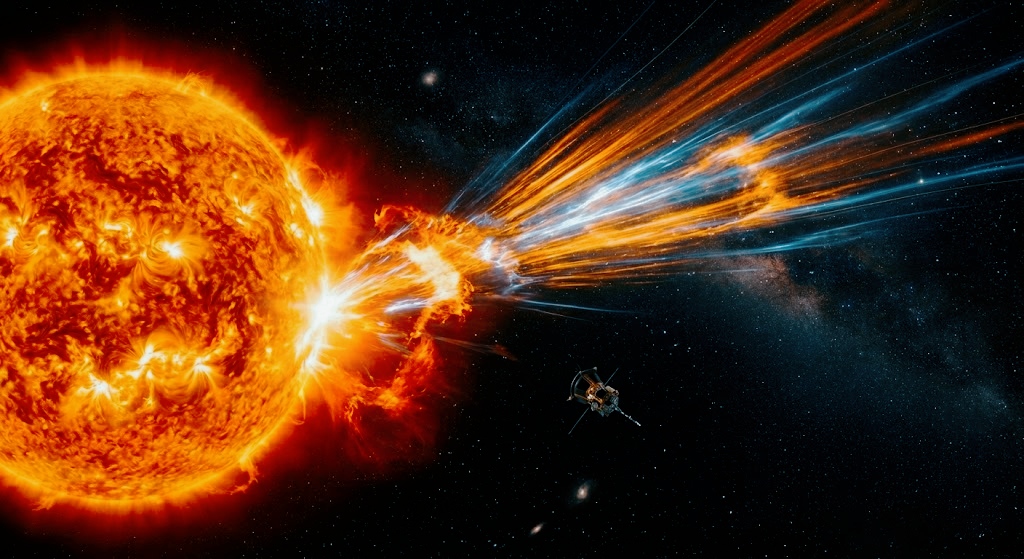
Solar radio bursts are intrinsically connected to the movement of their emitting sources through the coronal and heliospheric plasma. The transport of electrons responsible for these phenomena is primarily confined to magnetic field lines. Moving at a significant fraction of the speed of light, these electrons frequently generate radio emissions through the complex process of plasma emission.
The diagnostic utility of solar radio bursts in heliophysics
The resulting radio emissions, particularly type III bursts generated by electrons propagating along open field lines, serve as an exceptional diagnostic tool for understanding the environments through which they travel. By tracing the backbone of a radio burst via its peak intensity, researchers can accurately determine the frequency drift rate. This measurement provides critical insights into the physical properties and the dynamic nature of the solar atmosphere.
For an electron beam traveling along a radial path, the expected frequency drift rate typically decreases gradually over time. However, the drift rates of type III bursts can exhibit significant variations over smaller frequency scales. Fine structures, such as striae formed by density fluctuations along the beam’s path, can produce substantial changes in the drift rate during the burst’s duration.
Magnetic field structures and morphological variations in dynamic spectra
When an emitter moves along a coronal loop, the drift rate may reduce to zero and subsequently reverse direction. This phenomenon provides a clear demonstration of how large-scale magnetic field structures directly influence the morphology of bursts within dynamic spectra. Given the turbulent nature of the solar atmosphere, it is necessary to verify if variations in type III burst drift rates can be explained by magnetic field deviations.
Such deviations may include large-scale inversions or deflections that alter the path of the emitting electrons. To investigate these possibilities, researchers analyzed 24 interplanetary type III bursts observed by the Parker Solar Probe over the course of one week. Peak frequencies were converted into distance measurements and compared against polynomial interpolations to determine specific spatial offsets.
A noise level of 0.57 solar radii was estimated for these measurements, meaning any deviations exceeding this threshold indicate real physical disturbances. Out of the 24 events studied, 50% displayed deviations beyond this level, with an average displacement of 1.1 solar radii. These findings suggest that substantial perturbations in the propagation path are a common feature of interplanetary radio bursts.
Interpreting density fluctuations and magnetic deviations in the heliosphere
The observed phenomena can be explained by density variations of 10% to 30% or by magnetic field deviations ranging from 23 to 88 degrees. These variations occur over spatial scales spanning 1.8 to 6.4 solar radii. The study further identified four specific type III bursts that exhibited some or all of the characteristics predicted by theoretical simulations.
In these specific bursts, the observed variations are most plausibly explained by magnetic field deviations, such as switchbacks, rather than unrealistically large density variations along the field. While density fluctuations do play a role, the degree of deviation in these cases strongly points toward the influence of magnetic geometry. This distinction is vital for accurately modeling the inner heliosphere’s structural complexity.
These results demonstrate that variations in type III burst profiles can arise from both magnetic and density fluctuations. They underscore the immense value of type III bursts as remote probes of the internal structure of the heliosphere at kilometric wavelengths. Such research continues to refine our ability to use radio observations to map the invisible magnetic framework of the solar system.
The study is published in The Astrophysical Journal.