
The global challenge of plastic pollution is fundamentally rooted in a structural paradox where materials designed for transient use possess chemical stabilities that span centuries. Traditional disposal methods often fail to mitigate the environmental accumulation of these polymers, leading to persistent waste and the pervasive issue of microplastics.
Living plastic: a programmable solution for controlled material degradation
Recent scientific advancements are now pivoting toward a transformative strategy known as “living plastics,” which seeks to align the physical lifespan of a product with its functional utility. By incorporating dormant biological agents directly into the material matrix, researchers are developing a new class of polymers capable of autonomous and complete decomposition.
This innovative approach essentially transforms the material into a biological hybrid. Instead of relying on external environmental factors that may take decades to act, the degradation mechanism is pre-installed within the plastic itself, waiting for a specific command to begin the breakdown process.
The biological mechanism of programmed destruction
The concept of living plastics relies on the fundamental ability of certain microorganisms to secrete enzymes that break down complex polymeric chains. Many microbes naturally possess the tools to digest organic matter, and by genetically tailoring these capabilities, scientists can redirect this power toward synthetic polymers.
As plastics are essentially long chains of molecules, these enzymes act as chemical scissors. By integrating the microbes or their enzymes directly into the plastic during production, the material effectively “comes to life” when triggered, ensuring that its structural integrity is compromised only when it is no longer needed.
According to lead researcher Zhuojun Dai, the goal is to transform durability from an environmental liability into a programmable feature. This paradigm shift allows for the creation of materials that are as robust as traditional plastics during their use phase but remain inherently temporary in the grander ecological timeline.
Synergistic enzymatic action for complete decomposition
While previous attempts at biodegradable plastics often relied on a single enzyme, new research has moved toward a more efficient dual-enzyme system. By genetically modifying Bacillus subtilis to produce two cooperative enzymes, a team of scientists has managed to significantly accelerate the degradation process.
The synergy between these enzymes is crucial for a clean breakdown. One enzyme acts as a random cleaver, cutting the long polymer chains into smaller segments, while the second enzyme systematically dismantles these pieces into their original monomeric units from both ends of the chain.
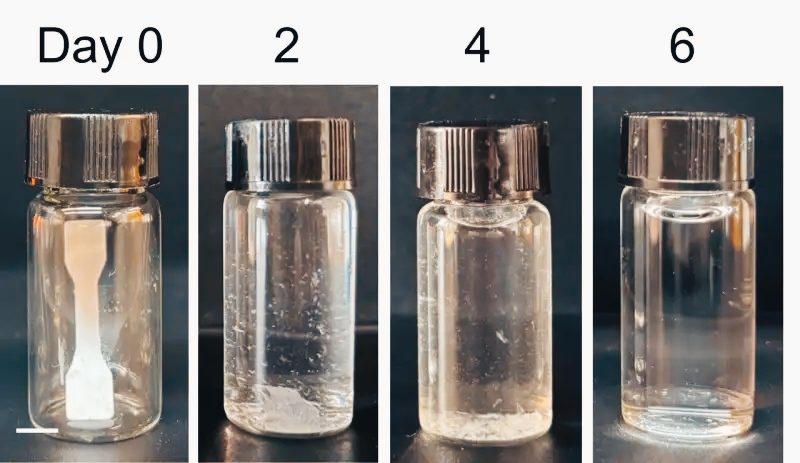
This coordinated biological attack proved so effective that it achieved total decomposition of polycaprolactone within just six days. Most importantly, the efficiency of this tandem process prevents the formation of microplastics, ensuring that the material returns to its basic building blocks without leaving harmful residues.
Practical applications and future environmental prospects
To demonstrate the feasibility of this technology, researchers successfully developed a wearable plastic electrode that performed its intended functions before being fully degraded within two weeks. The microbes are safely embedded as dormant spores, protected within the polymer until they are activated by specific conditions.
The activation process currently requires a nutrient broth and a specific temperature, which triggers the spores to wake up and begin consumption. This ensures that the plastic remains stable during storage and normal use, only initiating its self-destruction sequence when deliberately placed in a disposal environment.
Future research aims to adapt this strategy for a wider variety of polymers, including those commonly used in everyday single-use items. By developing activation mechanisms that work in aquatic environments, scientists hope to address the critical issue of ocean pollution, offering a scalable solution for a cleaner planet.
The study is published in Applied Polymer Materials.