Have you ever wondered why, on the first day of May, millions of people across more than 60 countries stop working to honor… work itself? It sounds like a beautiful contradiction, doesn’t it?
We welcome you to FreeAstroScience.com, where we turn complicated ideas into clear, human stories. Today we’re stepping out of the stars and into the streets of Chicago, 1886. We promise this isn’t a dusty history lesson. It’s about people who fought for the simple right to sleep, to love, to live. Stay with us until the very last line, because the ending will give you something to carry with you long after you close this tab.
📖 What You’ll Find Inside
- What Was the Dream of Eight Hours?
- How Did Chicago Become the Heart of the Fight?
- What Really Happened at Haymarket Square?
- Who Were the Chicago Martyrs?
- Why Does America Celebrate in September?
- How Did Europe Choose May 1st?
- Why Did Italians Have to Fight Twice?
- A Quick Timeline: When Did It All Happen?
- How Did Art Capture the Struggle?
- What Did Freud and Celentano Have to Say?
- How Did the Church Join the Celebration?
What Was the Dream of Eight Hours? {#dream-8-hours}
Picture this: it’s 1855 in Australia. A simple, almost poetic phrase is born among stonemasons working on Melbourne University: “Eight hours of work, eight of leisure, eight to sleep.” That’s not just a slogan. It’s a complete blueprint for being human.
The math is disarmingly simple. Let us show you:
24 h = 8(work) + 8(leisure) + 8(sleep)
A day, perfectly cut in three.
Why did this little equation matter so much? Because in late-1800s factories, men, women, and children worked up to 16 hours a day. Sixteen. Imagine starting at sunrise and stopping when most of us are deep asleep. No time to read a book, hold a child, or look at the sky.
That slogan wasn’t asking for a luxury. It was asking for a life.
How Did Chicago Become the Heart of the Fight?
By the second half of the 19th century, American workers started to gather, talk, and organize. One group stood out: the Knights of Labor. They wanted three things, and they wanted them now:
- An end to child labor
- Better factory conditions
- An eight-hour workday
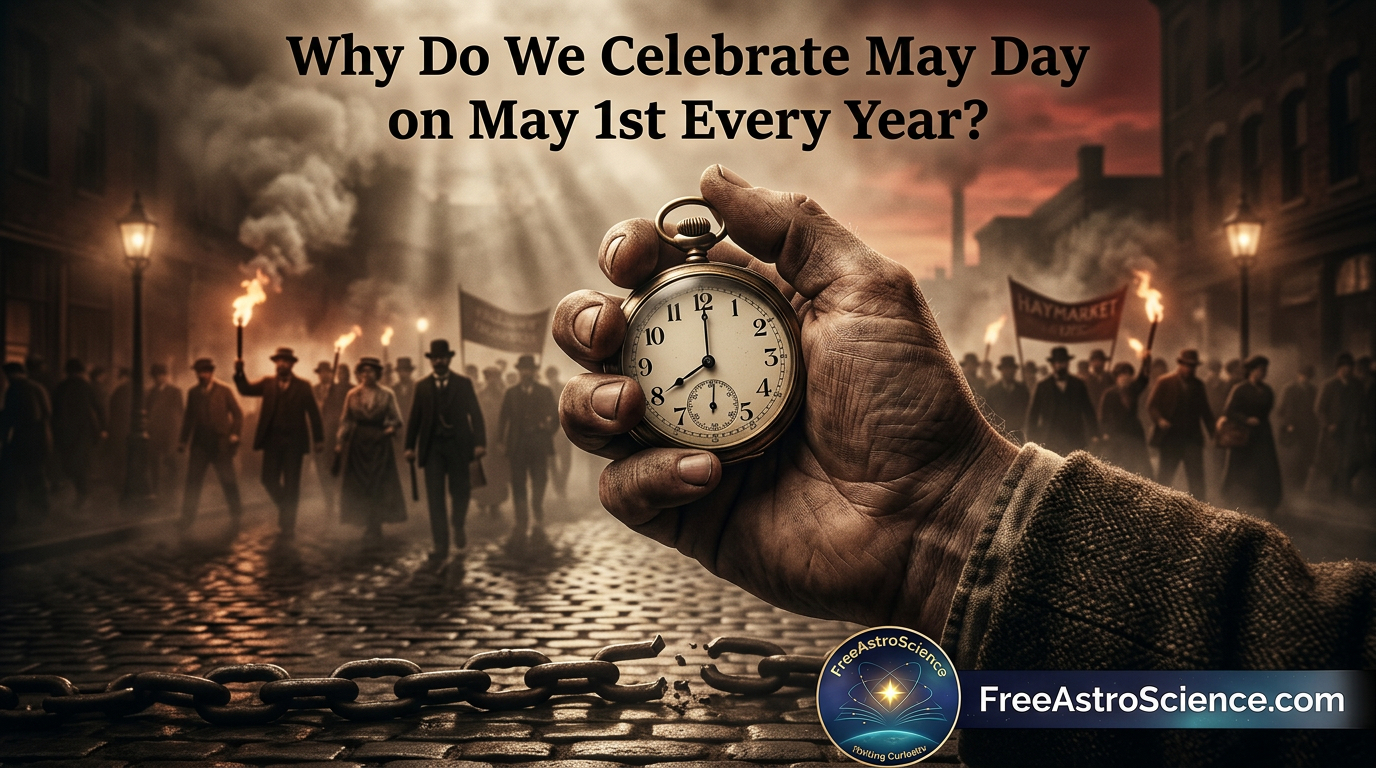
On May 1, 1886, the Federation of Organized Trades and Labor Unions called for a national strike across the United States. Tens of thousands marched. The epicenter? Chicago. Workers from every union and several anarchist movements joined hands in the streets.
Two days later, the dream cracked open. On May 3, 1886, in front of the McCormick Harvesting machine factory, police opened fire on striking workers. Some died. Their names blurred into history, but their blood was real.
What Really Happened at Haymarket Square?
Anarchist organizers, furious at the McCormick killings, called another rally for May 4, 1886, at Haymarket Square. The atmosphere was tense but peaceful. Speakers stood on a wagon. The crowd listened.
Then, suddenly, a bomb exploded.
A police officer was killed instantly. Officers fired into the crowd. When the smoke cleared, the toll was heartbreaking: at least 7 police officers and 4 demonstrators dead. The exact number of civilian victims was never confirmed. We probably never will know.
What followed was a brutal crackdown on the entire labor movement. Eight anarchist activists were arrested. Five of them were sentenced to death.
Who Were the Chicago Martyrs?
Those five men became known as the “Chicago Martyrs”. They didn’t throw the bomb. Nobody ever proved who did. But they paid the price for ideas that frightened the powerful: dignity, fair hours, the right to a Sunday afternoon with your family.
Their names echo every May 1st, even when we don’t say them out loud. When we sit at a café on a sunny May morning, when we pick up our kids from school at four in the afternoon, when we sleep through the night, we owe a small piece of that to them.
Why Does America Celebrate in September?
Here’s a strange twist of history. In 1894, U.S. President Grover Cleveland thought about turning May 1st into the official Labor Day. Logical, right? It was the date the world remembered.
But Cleveland was nervous. He feared riots. He didn’t want the United States linked to socialist or anarchist movements. So he made a political move: he shifted Labor Day to the first Monday of September.
That’s why, even today, Americans and Canadians grill burgers in early September while the rest of the world raises flags on May 1st. Same celebration, two different calendars, born from the same fear of remembering too clearly.
How Did Europe Choose May 1st?
The echo of Haymarket crossed the Atlantic fast. In 1889, during the Second International Congress in Paris, delegates from major European countries made a bold decision. They chose May 1st as the international day of struggle for the eight-hour workday.
The first big unified demonstration happened on May 1, 1890. Workers marched in cities across Europe. Different languages, same hope. A young man in Berlin, a baker in Lyon, a steelworker in Sheffield — for one day, they breathed together.
Why Did Italians Have to Fight Twice?
Italy joined that very first celebration in 1890. Then something dark happened. In 1925, fascism suppressed the holiday. For 20 years, May 1st became just another working day. Songs were silenced. Posters were torn down.
Only in 1945, after the end of the war, did Italy restore Workers’ Day. Two decades of silence, then voices again. We Italians know what it means to lose a celebration and to win it back. That’s why, when we walk through the streets of Naples, Rome, or Milan on May 1st, we feel something deeper than a day off.
A Quick Timeline: When Did It All Happen?
We built this small visual map for you. It’s the whole story at a glance.
| Year | Place | What Happened |
|---|---|---|
| 1855 | Australia | Stonemasons coin “8 hours work, 8 leisure, 8 sleep” |
| 1886 May 1 | USA | National strike for the 8-hour workday |
| 1886 May 3 | Chicago | Police shoot strikers at McCormick factory |
| 1886 May 4 | Haymarket Square | Bomb explodes; 7 officers and at least 4 workers killed |
| 1889 | Paris | Second International picks May 1st as workers’ day |
| 1890 May 1 | Europe | First unified march across many cities |
| 1894 | USA | Grover Cleveland moves Labor Day to September |
| 1925 | Italy | Fascism abolishes May Day celebrations |
| 1945 | Italy | Workers’ Day is restored after the war |
| 1955 | Vatican | Pope Pius XII establishes St. Joseph the Worker |
| 1970 | Sanremo | Celentano wins with “Chi non lavora, non fa l’amore” |
How Did Art Capture the Struggle? {#art-protest}
Art always shows up where pain and hope meet. The fight for fair labor lit up posters, magazines, and paintings across Europe.
In France, newspaper covers showed workers marching through spring landscapes. Spring meant rebirth, you see. Flowers blooming alongside clenched fists.
In Italy, the magazine L’Aurora printed allegorical images for May 1st: a Venus rising from the sea (rebirth again), a man breaking chains (freedom from the slavery of work). Symbols travel faster than long speeches.
In England, painter Walter Crane of the Arts and Crafts movement drew posters supporting socialism and the workers’ movement. One of his recurring images was a train. Why a train? Because it represented the unstoppable advance of the working class against capital. Steel, steam, motion forward.
What Did Freud and Celentano Have to Say? {#freud-celentano}
Not everyone cheered the strikes. In 1970, Italian singer Adriano Celentano won the Sanremo Festival with his song “Chi non lavora, non fa l’amore” (“Those who don’t work, don’t make love”). The song dropped right after the “autunno caldo” of 1969 — an unprecedented wave of factory strikes in Italy.
Many heard the song as criticism of the protests, mocking workers who marched instead of working. Years later, Celentano explained he was actually mocking the critics of the strikes, not the strikers. Irony has a way of getting lost in translation.
Long before that, Sigmund Freud (1856–1939) had already explained why work cuts so deep into our identity. The father of psychoanalysis saw work as a key element of psychological and social balance. For Freud, loving and working were the two pillars of mental health. When you can’t find satisfaction in your job, your love life suffers too. The two are wired together inside us.
That’s why the eight-hour fight wasn’t just about hours. It was about being whole.
How Did the Church Join the Celebration?
May 1st was born in socialist and communist circles. So how did Catholics end up celebrating it too?
In 1955, Pope Pius XII created the feast of Saint Joseph the Worker, set on May 1st alongside the traditional March 19th feast. Joseph, the carpenter and earthly father of Jesus, became the Christian symbol of humble, honest labor. Saint of artisans and workers, his rough hands held both wood and grace.
It was a beautiful move. The Church was saying: this day belongs to anyone who works with dignity, no matter their flag or their faith.
What Should We Take Away From All This?
So here we are, you and us, on May 1st. We hope you’ve felt the weight of those names, those years, those bullets and those songs. The day off you might be enjoying isn’t just a square on a calendar. It’s a victory written in the blood of strangers who never knew you, but somehow loved you in advance.
The eight-hour day isn’t natural law. It’s a human invention, fragile, won inch by inch. In many corners of the world, it still doesn’t exist. Children still work. People still die at their jobs. The fight didn’t end in 1886, or 1890, or 1945. It continues in your inbox, in your contract, in the hours you spend away from the people you love.
This article was written specifically for you by FreeAstroScience.com, where we explain complex scientific and historical principles in simple words. Our mission is to teach you to never switch off your mind, to keep it active and questioning at all times — because, as Goya warned us, the sleep of reason breeds monsters. Come back to us soon. We’ve got more stories, more sky, more questions to share with you. Until then, take care of your eight hours. All three sets of them.
📚 Sources & Further Reading
- Focus.it — “Perché la Festa del Lavoro si festeggia oggi? La tragedia dei Martiri di Chicago e il sogno delle 8 ore” (primary source)
- Federation of Organized Trades and Labor Unions — historical archives on the May 1, 1886 strike
- Knights of Labor — historical documentation on labor union demands
- Second International of Paris (1889) — Congress proceedings on the May 1st declaration
- Sigmund Freud — writings on the psychology of work and love (1856–1939)
- Pope Pius XII — establishment of Saint Joseph the Worker (1955)
- Adriano Celentano — *”Chi non lavora, non fa l’amore”*, Sanremo Festival 1970
Article researched and written by Gerd Dani for FreeAstroScience.com — keep your mind awake.