The Space Warps citizen science project, hosted on the Zooniverse platform, invites the public to contribute to the identification of elusive strong gravitational lenses. By analyzing images captured by the European Space Agency’s (ESA) Euclid telescope, participants assist in illuminating the nature of dark matter and dark energy. This initiative bridges the gap between massive datasets and human intuition, providing an unprecedented opportunity for individuals to engage in groundbreaking astrophysical research and preview images that have yet to be released to the public.
The physics of gravitational lenses and the Euclid telescope
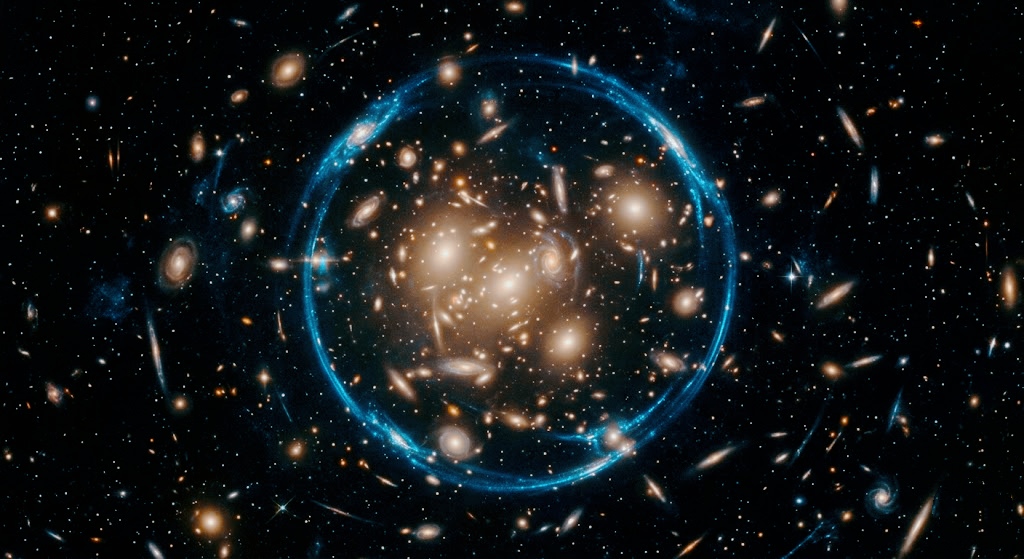
The distortions of spacetime, often relegated to the realms of science fiction, are fundamental phenomena observed in our universe as gravitational lensing. The immense gravity exerted by a massive object, such as a galaxy or a cluster of galaxies, warps the fabric of spacetime, thereby bending the trajectory of light emanating from distant sources positioned behind the lens. Rather than traveling in a straight line, this light curves around the intervening mass, which functions effectively as a cosmic magnifying glass.
This bending of light often produces multiple images of a single source, creates elongated arcs, or culminates in a complete circle known as an Einstein ring. Such intense gravitational lensing phenomena provide a profound empirical demonstration of Albert Einstein’s theory of general relativity. By leveraging these natural telescopes, astronomers can observe objects that would otherwise remain obscured or too distant to resolve, fundamentally altering our perception of the deep universe.
The Euclid telescope is currently revolutionizing the study of these phenomena by providing exceptionally sensitive imagery of vast sections of the sky with unprecedented detail. As the primary instrument for identifying rare gravitational lenses, Euclid captures data on a massive scale, recording approximately 100 gigabytes of information daily. This technological capability is essential, as the rarity of strong gravitational lenses necessitates an exhaustive survey of the heavens to ensure these elusive configurations are identified.
A collaborative approach to cosmic exploration
The sheer volume of data produced by the Euclid mission necessitates a sophisticated strategy for analysis, combining machine learning algorithms with human expertise. Within the first quick-release data set, researchers identified nearly 500 galaxy-galaxy gravitational lenses, despite these objects being nested within a mere 0.04 percent of the total available data. To manage the 72 million galaxies within the upcoming Data Release 1 (DR1), the Space Warps project utilizes artificial intelligence to pre-select 300,000 high-probability candidates for human inspection.
This refinement process involves rigorous data cleaning, a task spearheaded by scientists at the Ludwig Maximilian University of Munich and the Max Planck Institute for Extraterrestrial Physics. Because Euclid must observe through the Milky Way, the data is often cluttered with stars, nebulae, and other celestial phenomena that must be excluded to isolate potential lenses. By reducing millions of raw objects to a manageable set through machine learning, researchers have successfully mitigated the risk of overlooking significant gravitational lens detections.
Citizen scientists play a pivotal role in this pipeline by conducting the final visual verification of these candidates. Through the Space Warps interface, volunteers examine the high-quality imaging data, effectively performing tasks that require the nuance of human pattern recognition. This partnership between machine learning and public participation is not merely an educational exercise but a functional necessity, ensuring that the most promising candidates are validated and cataloged for professional follow-up.
Expanding the frontiers of cosmological research
Beyond the immediate discovery of new lenses, the research holds significant implications for our understanding of the universe’s evolutionary history. Strong gravitational lenses allow scientists to weigh galaxies and clusters by mapping the distribution of total mass, including both visible baryonic matter and elusive dark matter. Furthermore, by observing how these lenses change over cosmic time, researchers can derive critical data regarding the expansion of the universe and the role of dark energy, which drives the acceleration of that expansion.
The expectations for this project are extraordinarily high, with scientists anticipating the discovery of more than 10,000 new gravitational lenses. This figure represents an increase of more than four times the number of lenses identified since the first discovery nearly 50 years ago. Such a dramatic expansion in our catalog of strong lenses will provide a robust statistical foundation for testing current cosmological models and refining our theories regarding the fundamental forces that govern the structure of the cosmos.
Ultimately, the mission serves as a dual-purpose tool, exploring the expansion history of the universe through weak gravitational lensing and baryon acoustic oscillations, while simultaneously providing the high-resolution imagery required for strong lensing discovery. By integrating these various methods of observation, the astronomical community is moving toward a more comprehensive synthesis of the universe’s structure. Euclid’s ongoing survey promises to reshape our understanding of cosmic history, ensuring that the legacy of this mission remains central to astrophysics for decades to come.
Provided by Max Planck Society.