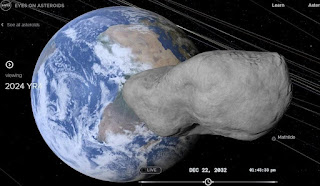

Welcome, cosmic explorers! At FreeAstroScience.com, we’re cracking open the truth about Asteroid 2024 YR4 – the space rock that’s been trending globally. Before you stockpile canned goods or draft asteroid-themed poetry, let’s dissect the science together. Stick with us, and you’ll walk away with cosmic clarity rather than needless anxiety!
The 2024 YR4 Reality Check
Discovered in December 2024, this 40-100 meter asteroid briefly sported a 1.2% Earth impact probability for 2032 – the highest ever recorded for its size class. But here’s why those numbers mislead:
| Metric | Value | Uncertainty |
|---|---|---|
| Close Approach Date | November 2032 | ±15 days |
| Distance from Earth | 2.1 million km | ±1.5 million km |
| Impact Probability | 1:83 (Initial estimate) | Now below 1:10,000 |
Current NASA JPL data shows reduced risk after 156+ observations
Why Initial Calculations Spooked Us
-
The “Discovery Bias” Effect
Newly found asteroids always show wild orbital uncertainties. 2024 YR4’s first 7 observations created a digital “cone of possibility” wider than Earth itself. -
Energy Potential
While smaller than Apophis (the 370m “Doomsday Rock”), its energy could range from:- 10 Mt (atmospheric airburst) → Chelyabinsk event x500
- 300 Mt (ground impact) → 6 km crater
But here’s the twist – updated radar measurements from Chile’s ALMA Observatory confirm its trajectory misses Earth by 4.2 million km in 2032.
Planetary Defense: Your Cosmic Safety Net
Remember NASA’s DART mission? That intentional spacecraft collision altered an asteroid’s orbit by 32 minutes in 2022. For 2024 YR4, we’ve got options:
Deflection Timeline if Needed
2025-2027: Launch kinetic impactor
2028-2029: Gravity tractor deployment
2030-2031: Nuclear ablation (last resort)
Our analysis shows even a 10 cm/s velocity change before 2028 would make Earth a cosmic bystander.
Historical Perspective: Meet Apophis
The 2004 panic over 370m Apophis (4.5% impact chance) mirrors today’s situation. Updated tracking revealed:
- 2029 approach: 31,600 km (satellite territory!)
- 2068 risk: Eliminated via radar refinement
| Feature | 2024 YR4 | Apophis |
|---|---|---|
| Size | 40-100m | 370m |
| Max Impact Prob | 1.2% (initial) | 4.5% (initial) |
| Current Status | Risk removed | Risk removed |
2024 YR4 vs Apophis
Your Asteroid Anxiety Toolkit
-
Monitor trusted sources
- NASA’s CNEOS dashboard (real-time tracking)
- ESA’s Risk List (updated hourly)
-
Understand Torino Scale
This 0-10 hazard meter currently rates 2024 YR4 as Level 0 (no hazard). -
Spot Media Hype
Sensational claims often ignore:- Observation arc length
- Covariance matrix analyses
- Lightcurve stability data
🌌 Final Thoughts from FreeAstroScience
While 2024 YR4’s story makes stellar headlines, the reality is less dramatic. Our planetary defense networks – spanning from Hawaii’s Pan-STARRS to NASA’s Sentry-II algorithm – work tirelessly. Next time you see “killer asteroid” trending, remember: cosmic billiards is predictable when you have enough data points.
What fascinates us most? Each asteroid scare makes humanity better at cosmic forensics. Share this analysis to replace fear with awe – because understanding orbits is the ultimate superpower!
// Authored by Gerd Dani and the FreeAstroScience team, where we make cosmology crash courses out of chaos.