From Leather to Trionda: The Full Evolution of the FIFA World Cup Soccer Ball (1930–2026)
Have you ever wondered how a simple soccer ball could spark controversy, inspire art, and even change the way we watch the World Cup? Welcome to FreeAstroScience.com, where we break down the science and stories behind the world’s most iconic objects—today, the FIFA World Cup soccer ball. Here, we believe that understanding the physics and history behind everyday things keeps our minds sharp and our curiosity alive. After all, the sleep of reason breeds monsters. Stick with us to the end, and you’ll see how a humble sphere became a symbol of innovation, culture, and global unity. Table of Contents
- The Early Days (1930–1966): What Did They Actually Play With?
- The Adidas Era Begins (1970–1982): How a Ball Changed TV Forever
- The Synthetic Revolution (1986–2002): When Science Took Over the Pitch
- The Engineering Leap (2006–2014): Fewer Panels, Bigger Drama
- Physics of the Perfect Kick: What Does Panel Count Actually Do to the Ball?
- The Modern Icons (2018–2022): Nostalgia, Chips, and Green Conscience
- The 2026 Trionda: What Makes the Newest World Cup Ball Special?
- A Full Timeline at a Glance
- Conclusion: More Than Just a Ball
- FAQ: World Cup Soccer Ball Evolution
- References
How the World Cup Soccer Ball Evolved: From Leather Laces to Trionda’s Four-Panel Wonder
The Early Days (1930–1966): What Did They Actually Play With?
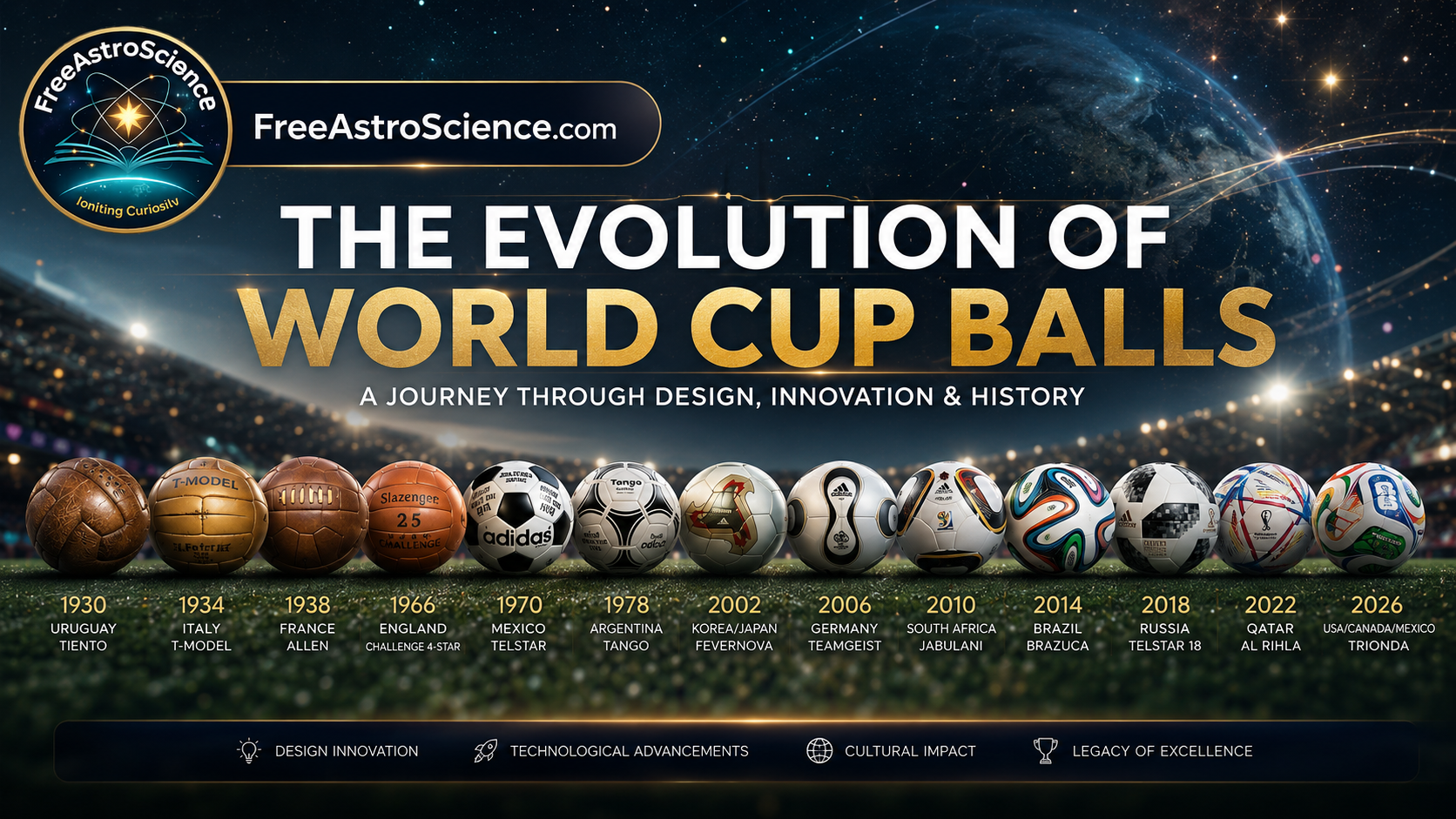
Let’s rewind to 1930. The first FIFA World Cup in Uruguay didn’t even have an official ball. Argentina and Uruguay each brought their own—one for each half of the final. These balls were hand-stitched leather, laced up like old boots, and soaked up water like sponges. The Federale 102 (1934) and Allen (1938) kept the stitched-leather tradition alive, but with rounder panels for a better roll. By 1950, the Duplo T introduced a molded rubber valve, finally ditching those painful external laces. The Swiss World Champion (1954) and Top Star (1958) added more panels—18 and 24, respectively—hoping for a truer bounce. In 1966, England’s Challenge 4-Star even came in orange for better visibility on muddy pitches. Still, these balls were heavy, waterlogged, and inconsistent. Each host nation made their own, so quality was a roll of the dice.
The Adidas Era Begins (1970–1982): How a Ball Changed TV Forever
Everything changed in 1970. Adidas took the reins and gave us the Telstar—32 black-and-white panels (20 hexagons, 12 pentagons) stitched into a near-perfect sphere. Why black and white? So fans could actually see the ball on black-and-white TVs. It was a stroke of genius, blending physics and design. The Telstar Durlast (1974) added a synthetic coating for better waterproofing. Then came the Tango Durlast (1978), with its 20-panel “triad” design that created the illusion of 12 circles—so iconic it set the style for two decades. The Tango España (1982) was the last real leather ball, with rubberized seams that tried (and mostly failed) to keep water out.
The Synthetic Revolution (1986–2002): When Science Took Over the Pitch
By 1986, science had truly arrived. The Azteca México was the first fully synthetic, polyurethane-coated ball. It was lighter, more durable, and didn’t soak up rain. Its Aztec-inspired design celebrated the host nation’s heritage. The Etrusco Unico (1990) added polyurethane foam and Etruscan art. The Questra (1994) used five materials, including polystyrene foam, for a softer touch and faster play—plus a space-age look. France’s Tricolore (1998) was the first multi-colored ball, with French flag and cockerel motifs. The Fevernova (2002) brought Asian-inspired graphics and a three-layer knitted cover, aiming for a more predictable flight.
The Engineering Leap (2006–2014): Fewer Panels, Bigger Drama
In 2006, the +Teamgeist changed the game again. It had just 14 curved panels, thermally bonded instead of stitched. This made the ball rounder, nearly waterproof, and more consistent. Thermal bonding means the panels are fused together with heat, creating a seamless surface. That reduces drag, keeps water out, and lets engineers control the ball’s shape down to the millimeter.
Then came the Jabulani in 2010—eight thermally bonded panels, a super-smooth surface, and a storm of controversy. Goalkeepers hated it. England’s David James called it “dreadful.” Italy’s Gianluigi Buffon said its flight was “unpredictable.” Even coach Sven-Goran Eriksson wanted a FIFA summit to address the chaos. The problem? Physics. With fewer seams and a slick surface, the ball’s boundary layer (the thin layer of air hugging the ball) separated unpredictably at certain speeds, causing wild swerves—what scientists call the “knuckling effect.” Scientific studies confirmed what players felt: the Jabulani was a wild card.
Adidas listened. The Brazuca (2014) had six panels, 68% longer seams, and a textured surface. Japanese researcher Takeshi Asai explained, “Because the Brazuca has a lower lift force when it flies, the so-called ‘knuckling’ effect will be harder to achieve.” Players loved it. No more furious complaints—just a ball that did what you expected, and even tweeted witty match commentary from its own account.
Physics of the Perfect Kick: What Does Panel Count Actually Do to the Ball?
Let’s get scientific for a moment. The classic 32-panel ball (a truncated icosahedron, like a soccer-ball-shaped molecule) is almost perfectly round. That means stable, predictable flight. But as panel counts dropped—32 to 14 (Teamgeist), 8 (Jabulani), 6 (Brazuca), and now 4 (Trionda)—the ball’s aerodynamics changed. Fewer panels mean fewer seams, which can make the ball fly faster but also more unpredictably, especially if the surface is smooth.
The “knuckleball” effect happens when a ball is struck with little or no spin. The airflow around the ball becomes unstable, and the ball can swerve or dip suddenly. This is all about the Magnus effect and boundary layer transitions. Even balls with the same panel count can behave differently if their surfaces are rough or dimpled. Panel orientation matters, too—non-spinning shots can experience weird side forces if the panels aren’t symmetrical.
| Ball | Panel Count | Surface Texture | Aerodynamic Stability | Knuckling Effect |
|---|---|---|---|---|
| Telstar (1970) | 32 | Leather, stitched | Very stable | Low |
| +Teamgeist (2006) | 14 | Smooth, thermally bonded | Stable | Moderate |
| Jabulani (2010) | 8 | Very smooth, thermally bonded | Unstable | High |
| Brazuca (2014) | 6 | Textured, deep seams | Very stable | Low |
| Trionda (2026) | 4 | Debossed, seamless | Expected stable | Low |
Magnus Force Formula:
F = (1/2) × ρ × v² × CL × A
Where F = Magnus force, ρ = air density, v = velocity, CL = lift coefficient (depends on panel/surface), A = cross-sectional area.
The Modern Icons (2018–2022): Nostalgia, Chips, and Green Conscience
The Telstar 18 (2018) brought nostalgia and tech together. Its pixelated pattern nodded to the original 1970 Telstar and the digital age. It even had an NFC chip—tap your phone, get stats. FIFA said, “The Telstar 18 evokes unforgettable memories of the 1970 FIFA World Cup – and of legends like Pele, Gerd Müller, Giacinto Facchetti, Pedro Rocha and Bobby Moore.”
Then came Al Rihla (2022), meaning “The Journey” in Arabic. It was the first World Cup ball made with water-based inks and glues—a big win for sustainability. Adidas called it the fastest and most accurate ball ever. Its design drew from Qatari architecture and art. For the semi-finals and final, the Al Hilm (“The Dream”) ball added “Connected Ball” tech to help referees make faster, more accurate calls. FIFA’s Jean-François Pathy summed it up: “This is a stunning, sustainable and high-quality Official Match Ball… designed with sustainability as a priority.”
The 2026 Trionda: What Makes the Newest World Cup Ball Special?
Now, the Trionda (2026) is here. Its name blends “Tri” (three) and “Onda” (wave in Spanish), celebrating the three host nations—USA, Canada, and Mexico—and the iconic “la ola” wave. It’s the first World Cup ball with just four panels, thermally bonded for a seamless surface. The graphics flow in red, green, and blue, echoing the hosts’ national colors, with gold details for a touch of trophy magic. Adidas calls it “the most visually playful FIFA World Cup ball” ever. Debossed lines and embossed country icons boost precision and in-flight stability. The pro version is 100% polyurethane; the competition version uses 60% polyurethane and 40% recycled polyester. It’s FIFA Quality Pro certified and ready for the world’s biggest stage.
| Ball | Year | Panels | Material | Key Features |
|---|---|---|---|---|
| Trionda | 2026 | 4 | 100% PU (pro); 60% PU/40% recycled polyester (comp) | Wave-inspired, debossed, seamless, tricolor, FIFA Quality Pro |
| Al Rihla | 2022 | 20 | Synthetic, water-based inks | Sustainable, fastest/most accurate, Qatari design |
| Telstar 18 | 2018 | 6 | Synthetic, NFC chip | Retro design, digital interaction, sustainable packaging |
| Brazuca | 2014 | 6 | Synthetic | Textured, deep seams, praised by players |
| Jabulani | 2010 | 8 | Synthetic | Smooth, unpredictable, controversial |
A Full Timeline at a Glance
| Year | Ball Name | Manufacturer | Panels | Key Features |
|---|---|---|---|---|
| 1930 | Tiento / T-Model | Various | 12–13 | Leather, hand-stitched, laced |
| 1934 | Federale 102 | Various | 13 | Leather, hand-stitched |
| 1938 | Allen | Various | 13 | Leather, rounder panels |
| 1950 | Duplo T | Various | 18 | Molded rubber valve, no laces |
| 1954 | Swiss World Champion | Various | 18 | Leather, improved water resistance |
| 1958 | Top Star | Various | 24 | Leather, selected from 102 models |
| 1962 | Crack | Various | 18 | Leather, similar to 1958 |
| 1966 | Challenge 4-Star | Various | 18 | Leather, orange for visibility |
| 1970 | Telstar | Adidas | 32 | Black/white, TV visibility |
| 1974 | Telstar Durlast | Adidas | 32 | Synthetic coating, waterproof |
| 1978 | Tango Durlast | Adidas | 20 | Triad design, polyurethane |
| 1982 | Tango España | Adidas | 20 | Leather, rubberized seams |
| 1986 | Azteca México | Adidas | 20 | Fully synthetic, Aztec design |
| 1990 | Etrusco Unico | Adidas | 20 | Polyurethane foam, Etruscan art |
| 1994 | Questra | Adidas | 20 | Polystyrene foam, space theme |
| 1998 | Tricolore | Adidas | 20 | Multi-colored, French motifs |
| 2002 | Fevernova | Adidas | 32 | Syntactic foam, Asian design |
| 2006 | +Teamgeist | Adidas | 14 | Thermally bonded, rounder |
| 2010 | Jabulani | Adidas | 8 | Thermally bonded, unpredictable |
| 2014 | Brazuca | Adidas | 6 | Textured, deep seams |
| 2018 | Telstar 18 | Adidas | 6 | NFC chip, retro design |
| 2022 | Al Rihla | Adidas | 20 | Water-based inks, sustainable |
| 2026 | Trionda | Adidas | 4 | Wave-inspired, recycled polyester |
Conclusion: More Than Just a Ball
From the heavy, rain-soaked leather balls of Uruguay 1930 to the Trionda’s four-panel, recycled-polyester marvel in 2026, the World Cup soccer ball has been a mirror for our times. Physics, materials science, and cultural storytelling have all shaped its journey. Each new ball tells a story—not just of sport, but of human ambition, creativity, and the drive to make things better. Next time you see a goal fly in, remember: that ball carries the weight of history, science, and dreams. Keep your mind active, and never stop asking questions. Come back to FreeAstroScience.com for more stories that keep reason awake.
FAQ: World Cup Soccer Ball Evolution
What is the official ball for the 2026 FIFA World Cup?
The official ball is the Adidas Trionda, featuring a four-panel, wave-inspired design and sustainable materials.
Why was the Jabulani ball so controversial at the 2010 World Cup?
Players and goalkeepers complained about its unpredictable flight, caused by its smooth surface and reduced panel count, which led to erratic “knuckling” in the air.
How has the number of panels on World Cup balls changed over time?
Panel counts dropped from 32 (Telstar, 1970) to 14 (Teamgeist, 2006), 8 (Jabulani, 2010), 6 (Brazuca, 2014), and now just 4 (Trionda, 2026).
What makes the Al Rihla the most sustainable World Cup ball before 2026?
Al Rihla (2022) was the first to use water-based inks and glues, reducing environmental impact and setting a new standard for sustainable soccer balls.
What does “thermally bonded” mean for a soccer ball?
Thermally bonded balls have panels fused together with heat, creating a seamless surface that improves aerodynamics, water resistance, and shape consistency.
References
- FIFA.com – Official World Cup Ball Announcements
- Adidas – Official Match Ball Releases
- ESPN – The Evolution of the World Cup Ball
- BBC Sport – World Cup Balls: A History
- The Guardian – Jabulani Ball Controversy
- Reuters – Brazuca Ball Review
- ScienceDirect – Soccer Ball Aerodynamics
- Nature Scientific Reports – Physics of Soccerll Flight