Have you ever wondered what lies behind the mysterious radio signals that sweep across the universe?
Welcome to FreeAstroScience.com, where we turn cosmic puzzles into stories you can understand. Today, we’re diving into Centaurus A—one of the strongest known radio sources and a favorite among amateur astronomers. Whether you’re a stargazer, a science lover, or just curious about what’s out there, you’re in the right place.
Stick with us to the end, and you’ll see how a galaxy 13 million light-years away can teach us about black holes, cosmic collisions, and the restless energy at the heart of the universe. Let’s keep our minds active—because the sleep of reason breeds monsters.
Table of Contents
- What Makes Centaurus A Special?
- How Was Centaurus A Discovered?
- What Does Centaurus A Look Like Through a Telescope?
- How Massive Is the Black Hole in Centaurus A?
- Why Is Centaurus A a Strong Radio Source?
- What Is the Story Behind the Dust Lane and Merger?
- How Do Scientists Study Centaurus A in Different Wavelengths?
- What Are the Latest Discoveries About Centaurus A?
- Can Amateur Astronomers Observe Centaurus A?
- Why Does Centaurus A Matter in Astronomy?
- Summary Table: Centaurus A Key Properties
- Conclusion
- References
Centaurus A: The Cosmic Powerhouse Next Door
What Makes Centaurus A Special?
Centaurus A, also known as NGC 5128, isn’t just another smudge in the sky. It’s the fifth brightest galaxy you can spot from Earth, shining at a visual magnitude of about 6.2 to 6.8. That means, under dark skies, you can catch it with binoculars or a small telescope. But what really sets Centaurus A apart is its wild energy. It’s one of the strongest radio sources in the universe, outshone only by a handful of cosmic giants like Cygnus A.
This galaxy is a radio galaxy—a type of galaxy that blasts out radio waves so powerful that they can be picked up by radio telescopes across the globe. The secret behind this cosmic beacon? A supermassive black hole at its heart, and two jets of particles shooting out at half the speed of light.
How Was Centaurus A Discovered?
Let’s rewind to April 29, 1826. James Dunlop, a Scottish astronomer working in Sydney, pointed his homemade 9-inch reflector at the constellation Centaurus. He spotted a “very singular double nebula”—what we now know as Centaurus A. John Herschel, observing from South Africa in the 1830s, described a “perfectly definite straight cut” through the galaxy, hinting at its famous dust lane.
But the real twist came in 1949. John Bolton, Gordon Stanley, and Bruce Slee, working at Dover Heights in Sydney, detected a powerful radio source in the same spot. They’d stumbled upon Centaurus A’s hidden side—a galaxy that doesn’t just shine, but roars across the radio spectrum. This discovery helped launch the field of radio astronomy and changed how we see the universe.
What Does Centaurus A Look Like Through a Telescope?
If you point your telescope at Centaurus A, you’ll see a bright, round glow split by a dark, jagged band. That’s the dust lane—a cosmic scar left by a galactic collision. The main body stretches about 60,000 light-years across, but the real action happens at the center.
To the naked eye, Centaurus A might not look all that different from other galaxies. But switch to radio or X-ray eyes, and it transforms into a powerhouse, with jets and lobes stretching over a million light-years.
How Massive Is the Black Hole in Centaurus A?
At the heart of Centaurus A sits a supermassive black hole weighing in at about 55 million times the mass of our Sun. That’s not just a big number—it’s a cosmic engine. This black hole is actively gobbling up gas and dust, forming a hot, swirling accretion disk. As matter spirals in, it heats up and spits out energy, lighting up the galaxy’s core as an active galactic nucleus (AGN).
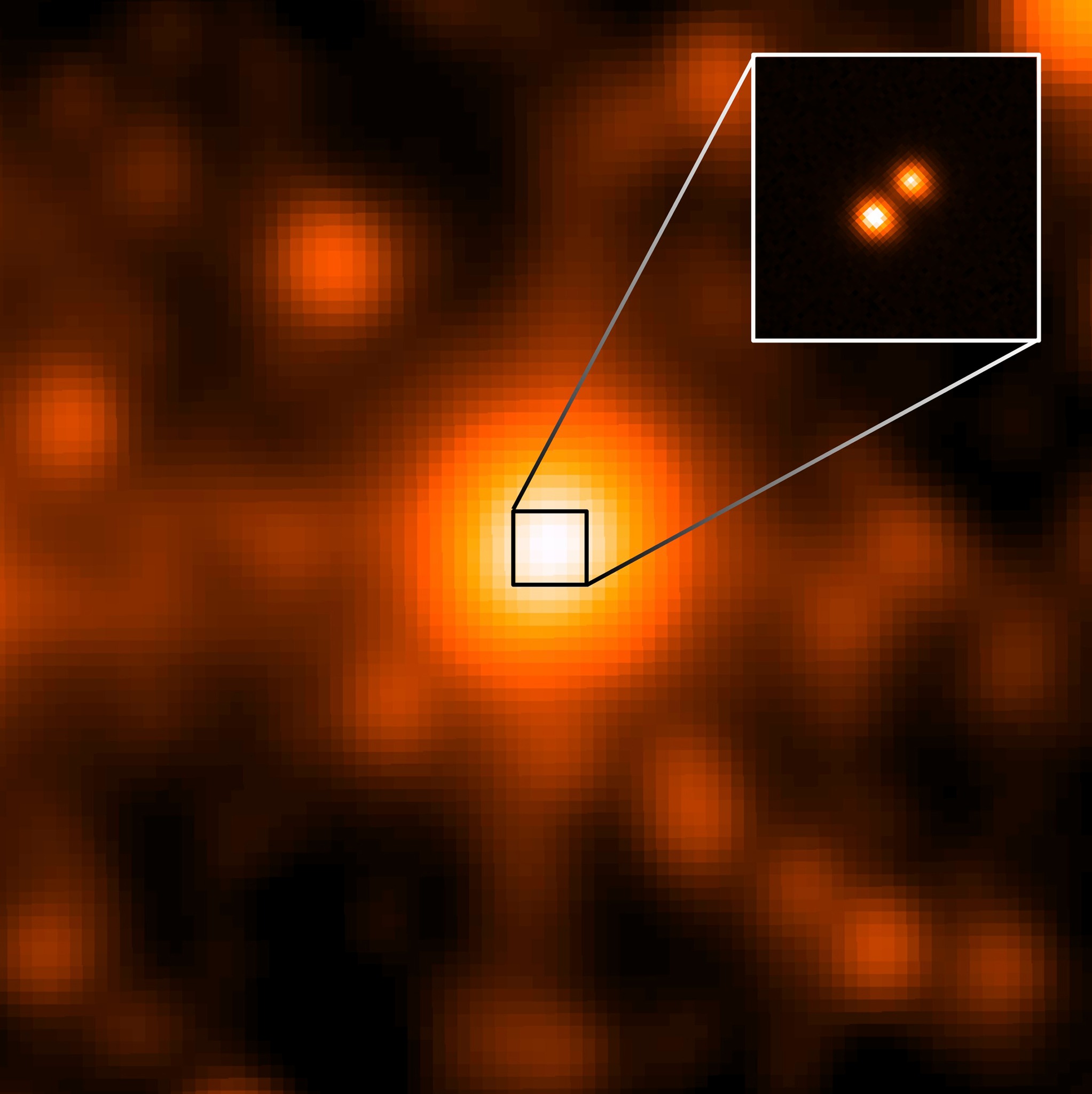
In 2021, the Event Horizon Telescope (EHT) zoomed in on Centaurus A’s core, pinpointing the jet-launching region to scales smaller than a single light-day. That’s like spotting a grain of sand from thousands of kilometers away. Multiple studies, including those using the SINFONI instrument on the ESO Very Large Telescope, have confirmed the black hole’s mass and its role as the galaxy’s powerhouse.
Why Is Centaurus A a Strong Radio Source?
Here’s where things get wild. Centaurus A is famous for its two polar jets—streams of particles blasting out from the nucleus in opposite directions. These jets are made of relativistic electrons and positrons, moving at about half the speed of light.
The jets don’t just stop at the edge of the galaxy. The inner jets stretch about 13,000 light-years, while the outer radio lobes balloon out over a million light-years. That’s more than ten times the size of the Milky Way!
What makes these jets shine so brightly in radio and X-ray? It’s all about synchrotron radiation. As the jets’ particles spiral around magnetic field lines, they emit energy across the spectrum. The jets are so powerful, they make Centaurus A the second strongest extragalactic radio source in the sky.
The process that launches these jets is called the Blandford-Znajek mechanism. In simple terms, the black hole’s spin and magnetic fields work together to fling matter out at incredible speeds. Recent EHT images show the jets are edge-brightened—a sign that the outer layers are glowing more than the center, a feature called limb-brightening.
What Is the Story Behind the Dust Lane and Merger?
That dark band slicing through Centaurus A isn’t just for show. It’s the aftermath of a cosmic collision. Between 100 and 700 million years ago, a giant elliptical galaxy swallowed a smaller, gas-rich spiral galaxy. The result? A warped, twisted dust lane packed with over 100 star-forming regions and young blue star clusters.
You’ll find cold molecular gas (traced by CO emission), faint shells, and filaments—evidence of the merger’s messy aftermath. This collision didn’t just reshape the galaxy; it also funneled gas toward the center, feeding the black hole and fueling the jets that make Centaurus A a radio giant.
How Do Scientists Study Centaurus A in Different Wavelengths?
Centaurus A is a favorite target for astronomers because it shines across the spectrum. Here’s how we see it:
- Submillimeter (APEX telescope): At 870 microns, APEX reveals cold dust and synchrotron emission, shown in orange in composite images.
- X-ray (Chandra X-ray Observatory): Chandra maps the jets and nucleus in blue, uncovering knots of X-ray emission from ultrarelativistic electrons.
- Optical (ESO/WFI): The ESO Wide Field Imager captures the galaxy’s stars and dust lane in visible light, showing the brown bands and background stars.
- Radio (VLA, ATCA): These arrays map the vast radio lobes and inner jets.
- Gamma-ray (Fermi): Fermi detects high-energy gamma rays from the jets and lobes.
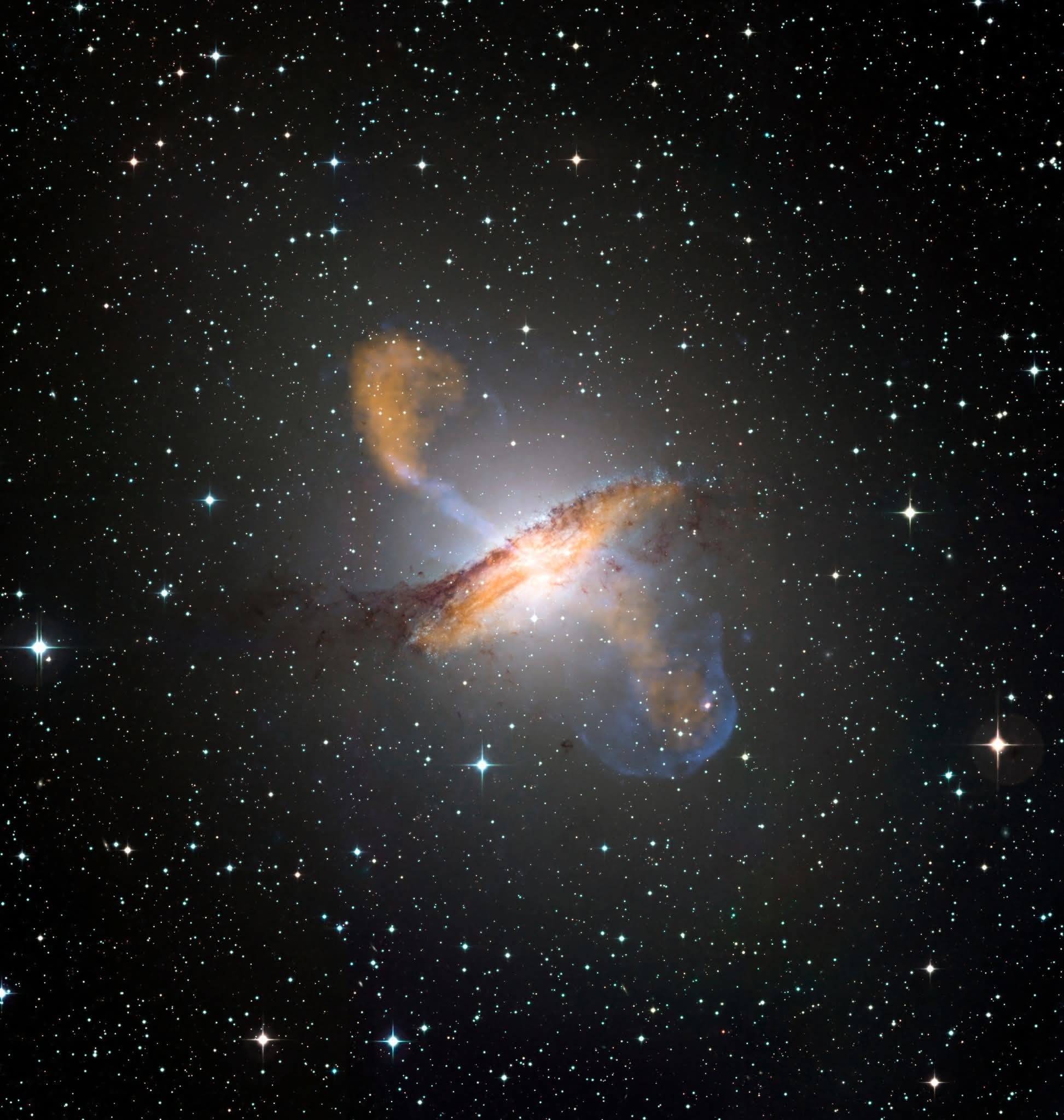
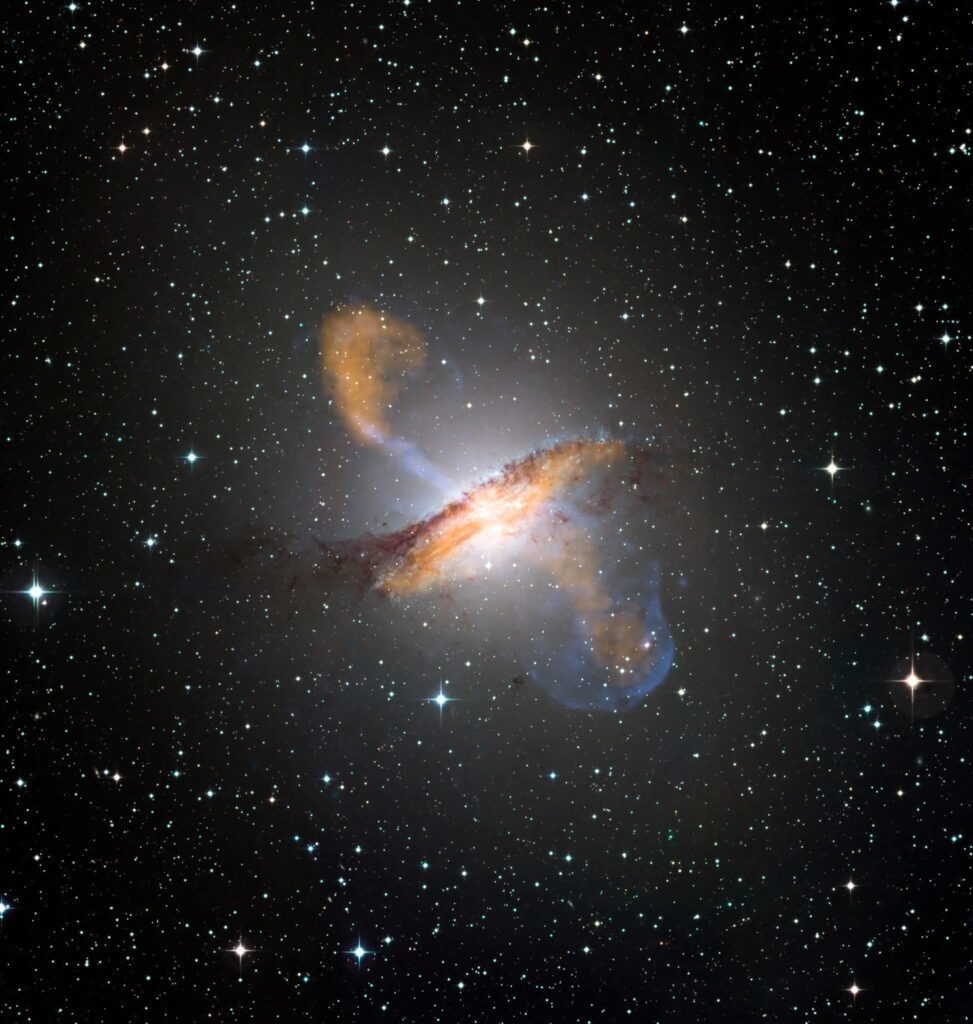
Multi-wavelength astronomy lets us piece together the full story, from cold dust to blazing jets. The image below combines these views, painting a portrait of a galaxy alive with energy. Composite image of Centaurus A: Submillimeter data from APEX (orange), X-ray data from Chandra (blue), and visible-light data from ESO telescopes (background stars and brown dust bands). Image credit: ESO/WFI (Optical); MPIfR/ESO/APEX/A.Weiss et al. (Submillimeter); NASA/CXC/CfA/R.Kraft et al. (X-ray).
What Are the Latest Discoveries About Centaurus A?
The last few years have been a golden age for Centaurus A research. In 2021, the Event Horizon Telescope delivered the sharpest images yet of the jet-launching region, revealing a highly collimated, edge-brightened jet and a brightness difference between the jet and counterjet.
IXPE, the Imaging X-ray Polarimetry Explorer, showed in 2024 that the X-ray emission from the jets is synchrotron radiation—meaning it comes from electrons moving near light speed in magnetic fields.
Scientists have also found that Centaurus A’s jets might be sources of ultrahigh-energy cosmic rays, with particles reaching energies above 10²⁰ electron volts. That’s mind-boggling power.
Looking ahead, the James Webb Space Telescope and next-generation radio arrays promise even more discoveries, possibly even imaging the black hole’s shadow.
Can Amateur Astronomers Observe Centaurus A?
Absolutely! Centaurus A is a favorite among amateur astronomy targets, especially in the Southern Hemisphere. With binoculars or a small telescope, you can spot its bright core and the famous dust lane.
Here are some tips:
- Best time to observe: Late autumn to early spring (Southern Hemisphere), when Centaurus is high in the sky.
- Location: Find a dark site away from city lights.
- Equipment: Binoculars will show a faint glow; a small telescope reveals the dust lane.
- What to look for: A round, bright nucleus split by a dark band.
If you’re in the Northern Hemisphere, Centaurus A sits low on the horizon, but it’s still worth a try if you’re far enough south.
Why Does Centaurus A Matter in Astronomy?
Centaurus A is more than just a pretty face. It’s a laboratory for studying how galaxies grow, collide, and change. Its active galactic nucleus, powerful jets, and merger history help us understand the life cycles of galaxies and the engines that power them.
As a Fanaroff-Riley Class I radio galaxy, Centaurus A sets the standard for how we study radio lobes, relativistic jets, and the feedback between black holes and their host galaxies. Its proximity—just 13 million light-years away—means we can study it in detail, testing theories about everything from jet formation to cosmic ray acceleration.
Summary Table: Centaurus A Key Properties
| Property | Value / Description |
|---|---|
| Other Names | NGC 5128, PKS 1322-427 |
| Galaxy Type | Peculiar Elliptical (Ep) / Lenticular (S0); Radio Galaxy (FR I) |
| Distance from Earth | ~13 million light-years (3.8 Mpc) |
| Visual Magnitude | 6.2 – 6.8 (fifth brightest galaxy in the night sky) |
| Diameter (Stellar Body) | ~60,000 light-years |
| Radio Lobes Size | >1 million light-years |
| Supermassive Black Hole Mass | ~55 million solar masses |
| Jets | Two polar jets, inner jets ~13,000 light-years, outer lobes >1 million light-years |
| Discovery | James Dunlop (1826, optical); John Bolton et al. (1949, radio) |
| Special Features | Prominent dust lane (merger remnant), active galactic nucleus, strong radio/X-ray emission |
Conclusion
Centaurus A is a cosmic powerhouse—a galaxy shaped by collisions, powered by a supermassive black hole, and blazing across the universe with jets that stretch for a million light-years. It’s a reminder that the universe is full of surprises, and that even the quietest patch of sky can hide a roaring engine of creation and destruction.
At FreeAstroScience.com, we believe that understanding galaxies like Centaurus A keeps our minds sharp and our curiosity alive. The more we learn, the more we realize how much there is left to discover. So keep looking up, keep asking questions, and remember: the sleep of reason breeds monsters.
Come back soon to FreeAstroScience.com—where we make the universe a little less mysterious, one story at a time.