Farewell Alex: A Life That Taught Us To Keep Going
Remembering Alex Zanardi, the champion who turned every fall into a reason to rise again
Dear readers, I’m Gerd Dani, writing from Rimini on a quiet morning that doesn’t feel quiet at all. At FreeAstroScience we usually talk about stars, equations, and the wonders of the universe. Today I want to talk about a human being who, in his own way, was a star too — one of those that keep shining long after the light is supposed to fade. I’ll keep the science simple, the emotions honest, and the story as true to the sources as I can.
A Silence That Felt Louder Than Any Engine
Alex Zanardi is gone.
The news reached me on Saturday, May 2, and I had to read it twice before I believed it. His family confirmed that Alessandro Zanardi passed away peacefully on the evening of May 1, 2026, at 59, surrounded by those who loved him most. There was no loud announcement, no final race — just a gentle goodbye from a man who had fought louder than almost anyone I’ve ever known of.
There’s something painful in the date. Zanardi died on 1 May, exactly 32 years after the world lost Ayrton Senna, another motorsport icon and one of his former rivals. Coincidence, sure. But as the BBC noted, the symmetry feels like something more — as if the universe was closing a circle it had opened a long time ago .
The Bologna Boy Who Chased Speed
Alex was born in Bologna on 23 October 1966, the son of a small-town plumber . I mention his roots because they matter. That he ever reached Formula 1 at all is, in the words of one writer, “a tribute to the inner drive that propelled him throughout his life” .
He raced in F1 between 1991 and 1994 with Jordan, Minardi and Lotus, then returned briefly with Williams in 1999 . His single-seater career in Europe never fully bloomed — the teams he joined were often in decline, and timing was cruel . But across the Atlantic, something magical happened.
In the U.S. CART championship, with Chip Ganassi Racing, Zanardi became a phenomenon. Back-to-back titles in 1997 and 1998. Fifteen wins, ten poles, twenty-eight podiums in sixty-six starts . And that famous last-lap pass on Bryan Herta at Laguna Seca’s Corkscrew — a move so bold it’s still taught as a lesson in pure audacity .
His nickname in the paddock? “The Pineapple.” Tough skin, sweet heart. That fits, doesn’t it?
The Day The World Held Its Breath
Then came 15 September 2001.
Just four days after the September 11 attacks, Zanardi was leading a CART race at Germany’s Lausitzring oval . Exiting the pits in the closing laps, he spun onto the track. Canadian driver Alex Tagliani hit him broadside at nearly 200 mph. The nose of Zanardi’s car was torn off — the BBC described it like “a bomb going off,” with a river of blood flowing onto the asphalt .
His heart stopped seven times. He survived for nearly an hour with less than a litre of blood in his body. Dr Steve Olvey and his medical team pulled him back from death by what can only be called a miracle of science and speed .
He lost both legs.
And here is where the Alex Zanardi most of us remember truly began.
“Who Cares About My Legs? I Am Alive.”
When he woke up in a Berlin hospital eight days later, he said something I want every young person to read at least once in their lifetime:
“I surprised myself feeling the highest joy I have ever had in my life. The pain was incredible. But I was alive. Who cares about my legs? I am alive.”
Let that sit for a moment.
I’ll be honest — as someone who lives with dystonia and moves through the world on wheels, I’ve read that quote dozens of times over the years. It never loses its power. Zanardi also said, looking back on the accident: “When I woke up without legs, I looked at the half that was left, not at the half that was lost” . You can build an entire philosophy of life on that single sentence.
He refused to be called a superhero. He kept saying that what was inside him was also inside the rest of us — a “hidden tank of energy that just comes out when needed” . That’s not motivational poster talk. That’s a man who had literally seen the other side and came back to tell us what he found.
The Engineer of His Own Comeback
Here’s a detail that tells you everything about him. The prosthetics on the market didn’t work well enough for him, so he basically became his own engineer, designing custom legs alongside specialists and adapting the technology to his needs . He even joked that he made himself a bit taller while he was at it .
That’s science serving humanity — exactly the kind of thing we celebrate at FreeAstroScience. Engineering as an extension of willpower. Physics as a tool for dignity.
In 2003 he returned to the Lausitzring in a CART car fitted with hand controls and symbolically completed the 13 laps remaining from the race he never finished . He lapped fast enough to qualify. Read that again. Fast enough to qualify.
Then came BMW, and the World Touring Car Championship from 2005 to 2009, where he won four races as a double amputee . His first victory came at Oschersleben on 29 August 2005 . A comeback crowned in steel and courage.
London, Rio, And Four Gold Medals
Motorsport gave him fame. Handcycling gave him immortality.
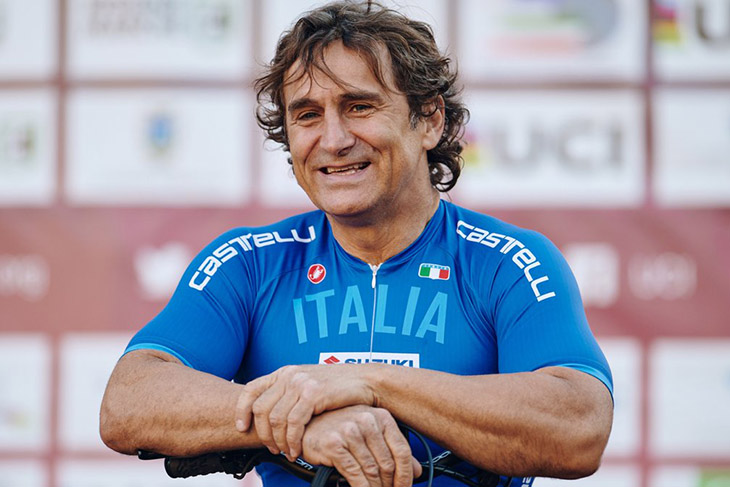
After finishing fourth at the 2007 New York City Marathon on just four weeks of training , he set his sights on the Paralympics. At London 2012, on the Brands Hatch circuit — a racing track, of course, because Alex’s story always circled back to asphalt — he won two gold medals and a silver . Four years later in Rio, he did it again: two more golds and another silver .
Four Paralympic golds. Two silvers. Twelve para-cycling world titles between 2013 and 2019 . He completed the Ironman World Championship in Hawaii in 2014 , and in 2018 set a record for a disabled athlete in an Ironman .
And still — still — he refused to let anyone call him special.
The Man Behind The Medals
What’s harder to capture in a headline is who Alex was when the cameras went off.
His lifelong friend Max Papis, godfather to Alex’s son, wrote that his hero had left him “with tears in my eyes but smiles in my heart” . Reporter Marshall Pruett described him as “an instant friend, filled with charm and child-like wonderment for life” . Almost every tribute from the motorsport world mentioned the same things: his humour, his humility, his warmth.
Through his “Bimbingamba” foundation, he helped children and young people who had suffered amputations but couldn’t access proper care . Through “Obiettivo 3”, he brought athletes with disabilities into sport . He didn’t just inspire from a stage. He built ladders for others to climb.
As someone who works in science outreach and disability advocacy, I can tell you: this is what real impact looks like. Not the applause. The ladders.
The Last Battle
Life, as Alex himself once said, is marvellous precisely because it brings both the fantastic and the terrible .
On 19 June 2020, during a charity handcycling relay near Pienza in Tuscany, he collided with a truck . The head injuries were devastating. For weeks, doctors feared he would never leave the hospital, never speak again . He spent years between hospital, rehabilitation, and his home in Padua, lovingly cared for by his wife Daniela and son Niccolò .
He retreated from public life. And yet, even in silence, his story kept teaching — proving, as one writer beautifully put it, that strength isn’t always loud .
What We Inherit
Italian Prime Minister Giorgia Meloni said Italy had lost “a great champion and an extraordinary man, capable of turning every trial of life into a lesson in courage, strength, and dignity” . Stefano Domenicali, F1 CEO and Alex’s friend, spoke of his “stubborn determination” and the smile he never lost . Chip Ganassi said the world had lost “one of its most extraordinary human beings,” a man who “didn’t just overcome adversity — he redefined what was possible” .
Cordiano Dagnoni, head of the Italian cycling federation, offered perhaps the most beautiful summary: Alex “transformed the culture of our country, bringing joy and happiness to those fortunate enough to know him, and hope to so many in Italy and around the world” .
He gave us, in Meloni’s words, “hope, pride, and the strength to never give up” .
Never give up. Three words. The compass I’ve tried to follow since I was a boy arriving in Italy from Albania for treatment in 1991. The same compass Alex pointed to every time he spoke, every time he pedalled, every time he smiled through pain that would have broken most of us.
A Personal Note, If You’ll Allow Me
I never met Alex Zanardi. But like millions of us who move through the world differently — with wheelchairs, with prosthetics, with conditions that rewrite the instructions of daily life — I feel like I lost a brother this weekend.
He taught me something that no textbook on physics or astronomy ever did: that the human body is not just mass, velocity, and bone. It’s also choice. It’s also attitude. It’s also, as he said, “an incredible machine, totally undiscovered in many ways” .
Science tells us the universe is mostly empty space held together by invisible forces. Alex’s life told us the same about people. What looks like limitation is often just undiscovered capacity waiting for the right reason to show itself.
Looking Ahead
So what do we do now, at FreeAstroScience and beyond?
We keep the ladders he built. We tell his story to kids who think their obstacles define them. We remember that resilience isn’t a superpower reserved for the few — it’s a muscle, trained by choice, sharpened by kindness, lit by purpose. The next time one of us is tempted to say “I can’t,” we’ll hear Alex’s voice whispering across the finish line: who cares about what you’ve lost — you are alive.
Ciao, Alex. Thank you for the laps, the medals, the jokes, the smile. Thank you for showing a boy in a wheelchair in Emilia-Romagna — and millions of others across the planet — that the finish line is never where we think it is.
The race goes on. And because of you, so do we.
With gratitude and a very heavy heart,
Gerd Dani — FreeAstroScience, Rimini